
A slip and fall injury can happen in seconds, but proving how it happened often determines whether an injury claim succeeds. Whether you were injured at Ontario Mills, a grocery store, an apartment complex, a warehouse property, a restaurant, or a commercial building along Euclid Avenue or Holt Boulevard, property owners are not automatically liable simply because a fall occurred. The key question is whether a dangerous condition existed and whether it should have been discovered, repaired, or addressed before someone was injured.
Since 1998, Pérez Law, PC has represented injured Californians in complex premises liability and personal injury cases. Our team recently secured a $2.6 million recovery in a single slip and fall case, demonstrating the significant consequences that unsafe property conditions can have on victims and their families.
From our Ontario office at 822 North Euclid Avenue, founding attorney Ricardo Antonio Pérez leads our team in investigating dangerous property conditions, preserving critical evidence, identifying liable parties, and building strong claims against negligent property owners and insurers. Before practicing law, he worked as a licensed private investigator and insurance claims adjuster. He knows how these cases are evaluated, minimized, and fought from the other side.
If someone else’s negligence caused your injuries, an Ontario slip and fall lawyer can help you pursue compensation for medical expenses, lost income, pain and suffering, and other losses.
Call our personal injury lawyers in Ontario at (909) 983-2235 for a free, no-obligation case evaluation.
Featured Result
$2,600,000 for a Minor Plaintiff Injured at a Major Retail Property.
Pérez Law, PC secured a $2,600,000 recovery in a personal injury matter involving a minor plaintiff who suffered a facial injury in an incident connected to a major retailer. Attorney Orion S. Robinson represented the plaintiff. Retail properties across the Ontario area, shopping centers, big-box stores, grocery chains, carry legal teams and insurance adjusters whose job is to limit what injured people recover. This result reflects what happens when the firm on the other side knows you are prepared to fight for every dollar.
Facial injuries to minors carry immediate medical costs, the likelihood of long-term treatment, and consequences that follow a child through their development. Pérez Law, PC, pursued full compensation for all of it.
View the case result. Past results do not guarantee future outcomes. Every case is different.
What Is Premises Liability Under California Law?
Premises liability is the area of California law that holds property owners, managers, and occupiers responsible when unsafe conditions on their property injure visitors. Slip and fall accidents are among the most common premises liability claims. The legal foundation is California Civil Code Section 1714, which states that everyone is responsible for injuries caused by their failure to exercise ordinary care in the management of their property. For property owners, that duty means inspecting the premises, identifying dangerous conditions, and either correcting the hazard or warning visitors about it before someone is hurt.
The duty applies broadly. Grocery stores, commercial landlords, shopping malls, restaurants, apartment complexes, and government entities are all covered. Under Rowland v. Christian (1968), California abolished the old categories of invitee, licensee, and trespasser and replaced them with one standard: did the property owner exercise reasonable care under the circumstances? Whether a duty existed, and how far it extended, depends on factors such as the foreseeability of harm and the specific conditions present at the time of the incident.
Actual Notice vs. Constructive Notice in California Slip and Fall Claims
California courts recognize two types of knowledge that can establish a property owner’s liability for a hazardous condition: actual notice and constructive notice.
Actual notice means the owner or an employee directly knew about the hazard. A store employee who saw a spill and did not clean it up is the clearest example of actual notice.
Constructive notice means the dangerous condition existed long enough that a reasonable inspection would have revealed it. A puddle spreading across a store aisle for 40 minutes gives the owner constructive notice, even if no employee saw it directly. The owner is treated as having known because they should have known.
Evidence used to establish notice includes surveillance footage, incident reports, employee schedules, maintenance logs, and inspection records. These documents show when the condition appeared and how long the owner had to address it before the injury occurred.
As your premises liability attorneys in California, we help you understand these rights and build the evidence needed to enforce them. If you believe you have a claim, contact us today for a free case review.
Common Causes and Locations of Slip and Fall Accidents in Ontario
Slip and fall accidents happen across Ontario’s retail and commercial landscape every day. According to the National Floor Safety Institute, falls account for more than 8 million emergency room visits annually in the United States, and they are the leading cause of workers’ compensation claims. In Ontario, the densely trafficked retail corridors, apartment complexes, and public sidewalks create a consistent source of these accidents.
Common causes of slip and fall accidents include:
- Wet or slippery floors due to spills, mopping, or leaks
- Uneven walking surfaces, cracked pavement, or raised floor transitions
- Poor lighting in parking structures, stairwells, and interior corridors
- Broken, loose, or missing handrails on stairs
- Loose carpeting, rugs, or floor mats
- Standing water or ice in parking lots and exterior walkways
- Debris, merchandise, or obstacles left in aisles
- Recently waxed or polished floors without wet floor signs
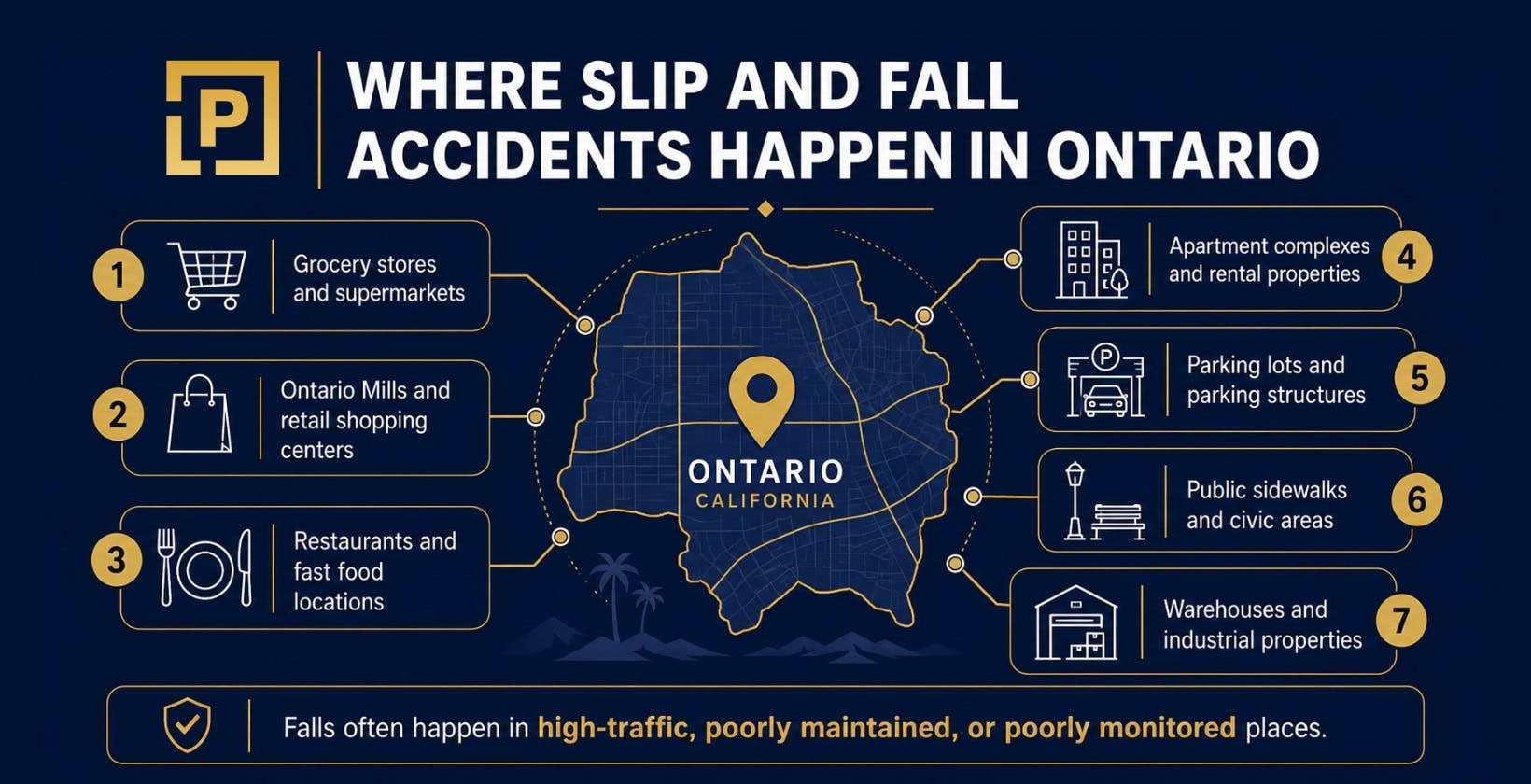
Common locations where these accidents occur in Ontario and the surrounding Inland Empire include:
- Grocery stores and supermarkets along the Euclid Ave and Holt Blvd corridors
- Ontario Mills and other large retail shopping destinations
- Costco and big-box retail locations near the Ontario Mills area
- Restaurants and fast food establishments throughout Ontario’s commercial strips
- Apartment complexes and rental properties along Euclid Avenue and surrounding streets
- Parking lots and parking structures at commercial properties
- Public sidewalks and government-maintained walkways
- Ontario Town Square and civic center areas
- Warehouses and distribution centers in the Ontario industrial corridor
Trip and fall accidents fall under the same premises liability framework as slip and fall claims in California. A raised threshold, uneven pavement edge, broken stair nosing, or piece of merchandise left in an aisle causes a trip, the same way a wet floor causes a slip. If you tripped and fell on unsafe property in Ontario, the same rules apply, and the same deadlines run. Schedule a free consultation to discuss your case.
What You Must Prove to Win a Slip and Fall Claim
California slip and fall cases are negligence claims. To succeed, you and your attorney must establish four legal elements, each proven by a preponderance of the evidence, meaning more likely true than not.
- Duty of Care: The property owner owed you a legal duty to maintain the premises in a reasonably safe condition. Under California Civil Code Section 1714, this duty applies to any lawfully present visitor, whether you were a customer, tenant, restaurant patron, or commercial property visitor.
- Breach: The owner failed to meet that duty. Leaving a spill unaddressed, failing to repair a broken step, or not maintaining adequate lighting are all examples of a breach.
- Causation: The hazardous condition must be what caused the fall and the resulting injury, not some other independent cause.
- Damages: You suffered actual harm: medical expenses, lost income, pain, and the impact on your daily life.
All four elements must be present. A fall without provable damages, or a hazard that did not directly cause your injuries, gives the defense grounds to defeat the claim. We investigate and build each element from the beginning, preserving the evidence needed to prove your case before it disappears.
Call (909) 983-2235 for a free case evaluation. Surveillance footage is gone within 72 hours. We can act today.
It was difficult enough to go through the pain and suffering from my back injuries. No one was as attentive, quick to respond, answer my questions and professional as Janie Thompson. My entire life changed after my injury, and the last thing I needed was to deal with my legal situation alone.
Common Slip and Fall Injuries
The injury from a slip and fall is not always obvious at the scene. Some of the most costly conditions, herniated discs, torn ligaments, and traumatic brain injuries, develop or worsen in the days following the fall. The injury type determines medical costs, treatment timeline, and case value.
- Hip Fractures: Most common in falls on hard flooring; frequently require surgery and extended rehabilitation, particularly in older adults. These cases carry significant long-term care costs that must be fully documented before any settlement is reached.
- Knee Injuries: Torn ligaments and cartilage damage from bracing a fall or landing on a hard surface. Insurers routinely argue that knee damage is pre-existing. Medical records and imaging taken close in time to the fall are critical to defeating that argument.
- Wrist and Hand Fractures: Result from instinctive outstretched-hand impact; often require casting or surgical fixation.
- Spinal Injuries: Compression fractures and disc herniation from impact or awkward landing; can produce chronic pain and limited mobility.
- Traumatic Brain Injury: According to the CDC, Facts About TBI, August 2025, falls account for nearly half of all TBI-related hospitalizations in the US. Head impact on floors, shelves, or fixtures ranges from concussion to severe TBI requiring long-term care.
- Shoulder Injuries: Rotator cuff tears and labral damage from lateral falls.
- Soft Tissue Injuries: Sprains, strains, and torn ligaments in ankles and knees. Despite causing real functional limitations, these injuries are systematically undervalued by adjusters because they do not appear on imaging. An attorney who knows how to document pain, limited mobility, and treatment history can counter low offers.
- Lacerations and Contusions: Cuts and bruising from contact with sharp edges, merchandise, or fixtures.
If you are unsure whether your injury supports a claim, call (909) 983-2235 for a free case evaluation.
Where Can Ontario-Area Patients Receive Medical Care: For serious injuries, Ontario-area patients are typically treated at Kaiser Permanente Ontario Medical Center (2295 S Vineyard Ave) or San Antonio Regional Hospital in Upland (999 San Bernardino Rd), with severe trauma cases transported to Arrowhead Regional Medical Center (400 N Pepper Ave, Colton), San Bernardino County’s Level I trauma center.
What to Do After a Slip and Fall Injury in Ontario
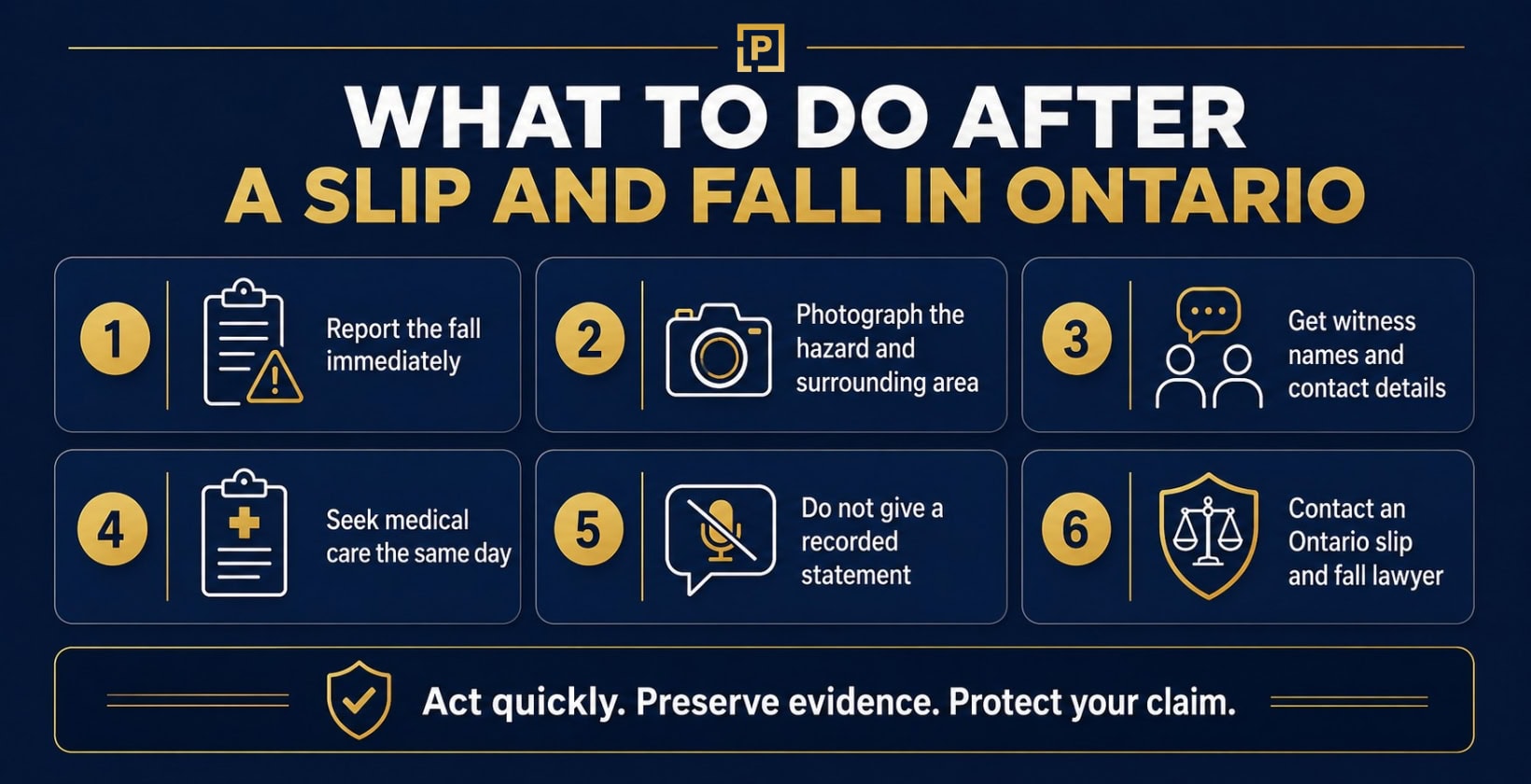
The steps you take in the hours after a slip and fall accident can make or break your case. Evidence disappears fast. Stores fix hazards, surveillance systems overwrite footage, and witnesses leave. The notice clock is already running the moment you fall.
- Report the accident immediately to the property manager, store manager, or responsible party on site. Insist on a written incident report and ask for a copy before you leave.
- Document the scene. Use your phone to photograph the hazard, the surrounding area, any warning signs (or the absence of them), your injuries, and your clothing and footwear.
- Get names and contact information from anyone who witnessed the fall.
- Seek medical care the same day, even if your injuries feel minor. Delayed treatment gives insurers grounds to argue your injuries were caused by something else.
- Do not give a recorded statement to the property owner’s insurance company. Insurance adjusters are trained to use your words to minimize your claim.
- Contact an Ontario slip and fall lawyer as soon as possible. Surveillance footage is often overwritten within 24 to 72 hours. Your attorney can send a preservation letter to prevent the destruction of evidence.
California Laws That Govern Your Slip and Fall Claim
Four California statutes directly govern slip and fall cases. Premises liability lawsuits filed in Ontario are heard at San Bernardino Superior Court (247 West Third Street, San Bernardino, CA 92415). You can review the full text of these statutes through the California Courts self-help resource center.
The Statute of Limitations
The statute of limitations for a slip and fall personal injury claim in California is two years from the date of the accident. Miss that deadline and you permanently lose your right to file a lawsuit and recover compensation, regardless of how strong your case is. Evidence deteriorates, witnesses forget details, and surveillance footage is gone within days. Two years sounds like a long time, but cases that are not investigated promptly are significantly harder to prove.
Government Property Falls: The 6-Month Deadline
CRITICAL: If your slip and fall happened on government-owned property, a city sidewalk, a public park, a government building, or any property owned or operated by a public entity, a shorter deadline applies. Under Government Code Section 911.2, you must file a formal government claim within six months of the date of the accident. Missing this deadline typically bars your entire claim, even if the two-year statute of limitations has not yet expired. If you fell on any public property in Ontario or San Bernardino County, contact us immediately.
California Pure Comparative Negligence
California’s pure comparative negligence system reduces the award by the plaintiff’s percentage of fault. Say someone slips on an unmarked wet floor at a grocery store on the Euclid Avenue corridor, and the insurer argues the person was looking at their phone. If a jury finds the plaintiff 30% at fault and total damages are $100,000, the recovery is $70,000, not zero. Property owners and their insurers push fault percentages as high as possible because each percentage point reduces what they owe. At a warehouse property or big-box retail location in Ontario, that argument often targets whether the visitor was watching where they were going or wearing appropriate footwear. An attorney challenges those assignments with evidence of the hazard’s visibility, the lighting conditions at the time, the absence of warning signs, and the property layout that made avoidance unrealistic.
Defenses Property Owners Use and How We Respond
Property owners and their insurers do not simply accept liability. They deploy specific defenses to reduce or deny your claim. Here is what to expect and how we counter each one.
|
What They Argue |
How We Respond |
|
“You weren’t watching where you were going.” |
We document the hazard, lighting conditions, warning sign absence, and property layout to show the fall was foreseeable and preventable regardless of where your attention was. |
|
“The hazard was open and obvious; anyone would have seen it.” |
An open and obvious condition does not automatically defeat a claim in California. We show why avoiding it was unreasonable given the specific circumstances at the time. |
|
“You didn’t see a doctor right away; it cannot be that serious.” |
We connect your medical records directly to the fall from day one, closing the gap insurers use to argue your injuries came from somewhere else. |
|
“We cleaned it up right away; it was a one-time thing.” |
Maintenance logs, employee schedules, and surveillance footage reveal how long the condition actually existed. We send a preservation letter immediately to prevent that evidence from disappearing. |
Compensation Available in a Slip and Fall Case
A successful premises liability claim can recover both economic and non-economic damages. The amount depends on the severity of your injuries, the impact on your life and ability to work, and the strength of the evidence.
Economic damages include:
- Medical bills: emergency care, hospitalization, surgery, physical therapy, imaging, and follow-up treatment
- Future medical expenses: costs of ongoing care, rehabilitation, and any long-term treatment needs
- Lost wages: income you were unable to earn because of your injuries
- Loss of earning capacity: if your injuries permanently limit your ability to work
- Out-of-pocket costs: medications, assistive devices, transportation to appointments
Non-economic damages include:
- Pain and suffering
- Emotional distress and anxiety
- Loss of enjoyment of life
- Permanent disability or disfigurement
Workplace Slip and Fall: When Workers’ Compensation Also Applies
If your slip and fall happened at your workplace, you may have rights under two separate legal systems. California workers’ compensation covers on-the-job injuries regardless of fault. This means even if you contributed to the fall, your employer’s workers’ compensation insurance is required to cover your medical treatment and a portion of your lost wages. You do not need to prove negligence to receive workers’ compensation benefits.
However, workers’ compensation is not the only option. If a third party’s negligence contributed to your fall, such as a property management company, a maintenance contractor, or a product manufacturer, you may also have a separate personal injury claim. These overlapping claims can significantly increase the total recovery available to you. Our firm handles both. Visit our workers’ compensation practice page to learn more, or call us to discuss how both claims may apply to your situation.
Why Hire Pérez Law, PC for Your Ontario Slip and Fall Case?
Most slip and fall attorneys in the Inland Empire have spent their entire careers on the plaintiff side. Ricardo Antonio Pérez has not. Before founding this firm, he worked as a licensed private investigator and insurance claims adjuster, managing personal injury cases from the defense perspective. He knows the surveillance review checklist adjusters run the morning after a fall. He knows which maintenance records they pull first and which gaps they look for. That background does not just inform how we investigate. It determines what we look for before the insurer does.
Five reasons clients in Ontario choose Pérez Law, PC:
- 27+ years as a licensed California attorney. Founded in 1998 by Ricardo Antonio Pérez (CA Bar #194646), admitted March 24, 1998, with roots in injury law going back to 1985.
- 4.8 stars across 195 Google reviews. Rated 4.8 at both the Ontario and Pomona offices, with repeated client praise for accessibility, communication, and case outcomes.
- Bilingual in English and Spanish. Our attorneys and the majority of our 36-person team serve clients in both languages. Se habla español.
- Members of the California Applicants’ Attorneys Association and the Los Angeles County Bar Association. Active professional memberships with the organizations that represent plaintiff-side injury attorneys in California.
- Millions recovered for seriously injured clients across a range of personal injury cases, including slip and fall accidents, car accidents, workers’ compensation, sexual harassment and assault, child sexual abuse, and employment law matters throughout California.
What Happens After You Call Pérez Law, PC:
- Free case evaluation. We review the facts, assess liability, and tell you directly whether you have a claim worth pursuing. No charge, no obligation.
- Evidence preservation. We send a preservation letter to the property owner immediately, stopping the destruction of surveillance footage, maintenance records, and incident reports.
- Investigation. We document the scene, obtain maintenance logs and employee schedules, and identify all liable parties, including property managers, contractors, and government entities where applicable.
- Medical coordination. We connect you with treatment providers and ensure your injuries are documented from the start, which protects both your health and your claim.
- Demand and negotiation. Once treatment is complete or a treatment plan is established, we submit a demand package to the insurer. Most cases resolve at this stage.
- Litigation, if necessary. If the insurer’s offer does not reflect the full value of your claim, we file suit and take the case through the San Bernardino Superior Court.
I had never been involved in a serious injury before, and I was scared and did not know how to navigate the situation. They made me feel at ease by always being available to answer my questions and ensuring I was well taken care of while seeking treatment.
Areas We Serve in Ontario and Surrounding Communities
Pérez Law, PC handles slip and fall cases from our office at 822 N Euclid Ave, Ontario, CA 91762, serving clients throughout San Bernardino County and the Inland Empire. We also serve clients from our Pomona branch office at 522 W Holt Ave.
Nearby communities we serve:
Rancho Cucamonga, Chino, Upland, Montclair, Fontana, Rialto, Colton, San Bernardino, Redlands, and Riverside.
Frequently Asked Questions About Slip and Fall Claims in Ontario, CA
How Long Do I Have to File a Slip and Fall Lawsuit in California?
The deadline to file a slip and fall lawsuit in California is 2 years from the date of the accident, under Code of Civil Procedure Section 335.1. Missing this deadline permanently eliminates the right to sue. The deadline shortens to 6 months for falls on government-owned property, under Government Code Section 911.2. Call us the day of the accident.
How Much Is a Slip and Fall Case Worth in California?
The value of a slip and fall case in California depends on 5 factors: injury severity, medical costs, lost income, comparative fault, and the strength of evidence against the property owner. Minor injury cases settle between $15,000 and $50,000. Cases involving surgery, permanent disability, or traumatic brain injury reach six or seven figures. Pérez Law, PC’s published results include a $2,600,000 recovery for a seriously injured plaintiff. Past results do not guarantee future outcomes. Every case is different.
How Long Does a Slip and Fall Case Take to Settle?
Most slip and fall cases in California resolve within 6 to 18 months. Cases involving serious injuries, disputed fault, or government defendants take longer. Settling before reaching maximum medical improvement undervalues the claim. An attorney accelerates the process by preserving evidence early and responding to insurer tactics before they delay resolution.
What Does Hiring a Slip and Fall Lawyer Cost?
Hiring Pérez Law, PC for a slip and fall case costs nothing upfront. The firm advances all case costs and collects a percentage of the recovery only if the case is won. No recovery means no attorney fees. The initial case evaluation is free and available 24/7.
Can I Still File a Slip and Fall Claim if I Was Partly at Fault?
Yes, partial fault reduces a slip and fall recovery in California, but does not eliminate it. California’s pure comparative negligence system reduces the award by the plaintiff’s percentage of fault. A plaintiff found 60% at fault recovers 40% of proven damages. Property owners’ insurers push fault percentages as high as possible because each percentage point reduces what they owe. An attorney challenges inflated fault assignments with evidence of the hazard’s visibility, lighting conditions, warning sign absence, and property layout.
Talk to an Ontario Slip and Fall Lawyer Today: No Fee Unless We Win
Trusted Injury Lawyers. Decades of Experience. Millions Recovered.
The property owner’s insurer is already building their case. Surveillance footage overwrites in 72 hours. Maintenance records get amended. Witnesses move on. Every day without an attorney is a day that evidence works against you instead of for you.
Pérez Law, PC has represented injured clients across the Inland Empire since 1998. The consultation is free, available 24/7, and there is no fee unless we win. Call (909) 983-2235 or start a free case evaluation online. Se habla español.