
Pérez Law, PC, represents traumatic brain injury (TBI) victims throughout Ontario, California, San Bernardino County, and the broader Inland Empire. Our office at 822 N Euclid Ave, Ontario, CA 91762 serves injured people along the I-10 corridor and throughout San Bernardino County who have suffered serious head injuries in car crashes, truck accidents, falls, and other negligence-based incidents.
Attorney Ricardo Antonio Pérez has worked in the injury law field since 1985, first as a licensed private investigator, claims adjuster, and manager of two personal injury firms before founding Pérez Law, PC in 1998. That background gives him nearly four decades of experience understanding how insurers build and value catastrophic injury claims, including severe head injury and TBI cases. Managing Attorney Ricardo Agustín Pérez has personally overseen catastrophic personal injury cases, including those involving TBI. If you or a family member has suffered a brain injury caused by someone else’s negligence, call (909) 983-2235 for a free consultation. Se habla español. Available 24/7.
Past results do not guarantee future outcomes. Every case is different.
FREE CASE EVALUATION. NO WIN, NO FEE. Call (909) 983-2235 or contact us online. Se habla español. 24/7.
FEATURED RESULT: $2,600,000
$2,600,000 — Catastrophic Injury to a Minor Plaintiff Pérez Law, PC recovered $2,600,000 for a minor plaintiff in a catastrophic personal injury matter.
Past results do not guarantee future outcomes. Every case is different.
What Is a Traumatic Brain Injury?
A traumatic brain injury (TBI) is any disruption of normal brain function caused by a bump, blow, jolt, or penetrating object to the head. According to the Centers for Disease Control and Prevention (CDC), approximately 1.7 million Americans sustain a TBI every year, and the consequences can range from brief disorientation to permanent disability or death. TBI is not a single injury; it is a spectrum of neurological damage that affects each person differently, depending on the mechanism of injury, the area of the brain affected, and how quickly the injury is diagnosed and treated.
TBIs are generally classified as mild, moderate, or severe. Severity is commonly measured using the Glasgow Coma Scale (GCS), a neurological assessment tool scored from 3 to 15. A GCS of 13 to 15 indicates mild TBI; 9 to 12 indicates moderate TBI; 8 or below indicates severe TBI. Insurance adjusters use the initial GCS reading to argue that injuries were minor even when post-concussion symptoms persist for months or years. That is one reason why early, documented neurological follow-up is critical to your claim.
Types of Traumatic Brain Injuries
Understanding the type of TBI you have sustained affects diagnosis, treatment, and the value of your legal claim. The following categories are all recognized in clinical practice and personal injury litigation:
- Mild TBI / Concussion: The most common form. A concussion occurs when the brain moves rapidly inside the skull, disrupting neural function. Symptoms, such as headaches, confusion, nausea, and light sensitivity, may seem manageable but can become chronic. Insurance companies routinely undervalue concussion claims by pointing to a normal CT scan, even though CT imaging does not capture all concussion damage.
- Moderate TBI: Involves loss of consciousness from 30 minutes to 24 hours and post-traumatic amnesia up to a week. Cognitive and physical symptoms are more pronounced and often require inpatient rehabilitation.
- Severe TBI / Diffuse Axonal Injury (DAI): Diffuse axonal injury (DAI) is one of the most devastating forms of TBI, occurring when the brain’s long connecting nerve fibers (axons) are sheared or stretched across widespread brain regions. DAI typically results from high-speed impacts such as truck collisions on the I-10 or SR-60. Victims frequently experience prolonged coma, persistent vegetative state, or profound cognitive impairment.
- Coup-Contrecoup Injury: This injury occurs when the brain strikes the skull at the point of impact (coup) and then rebounds and strikes the opposite side of the skull (contrecoup), causing damage on both sides. High-speed crashes involving sudden deceleration, common on the I-10 corridor through Ontario, are a frequent mechanism.
- Penetrating TBI: An open TBI occurs when an object pierces the skull and enters brain tissue. Penetrating injuries are often fatal or result in severe permanent impairment.
- Post-Concussion Syndrome (PCS): Post-concussion syndrome (PCS) is a collection of symptoms, including persistent headaches, cognitive fog, memory impairment, light and sound sensitivity, sleep disturbance, depression, and irritability, that persists weeks, months, or years after the initial concussion. PCS is frequently dismissed by insurance adjusters because symptoms are subjective and imaging is often negative. Neuropsychological evaluation is essential to document PCS.
Common Causes of Traumatic Brain Injury in Ontario and the Inland Empire
Ontario sits at the intersection of the I-10 and I-15 freeways, two of the highest-volume freight and commuter corridors in California. The Inland Empire’s heavy truck traffic, high-speed freeway interchanges, and dense urban streets create a concentrated environment for serious accident-related TBI. Many Ontario-area TBI patients are initially treated at Arrowhead Regional Medical Center (400 N Pepper Ave, Colton, CA 92324), San Bernardino County’s Level I trauma center, or at Desert Valley Hospital (16850 Bear Valley Rd, Victorville). A documented trauma center record, especially one that includes a GCS assessment, is foundational to establishing TBI severity in litigation. The Brain Injury Association of America identifies motor vehicle crashes as the second leading cause of TBI in the United States, responsible for a disproportionate share of severe and fatal cases.
- Car accidents on the I-10, SR-60, I-15, and local streets: High-speed rear-end collisions, T-bone crashes at intersections, and head-on collisions all generate the rapid deceleration forces that cause the brain to impact the inner skull. Our Ontario car accident lawyer page addresses how we handle the full scope of collision claims.
- Commercial truck crashes: A fully loaded semi-truck weighing up to 80,000 pounds produces catastrophic impact forces. Truck collisions on the I-10 through San Bernardino County are among the most severe injury-producing crashes in the region. We discuss this further on our Ontario truck accident lawyer page.
- Motorcycle accidents: Riders face dramatically heightened TBI exposure. Even helmeted riders suffer TBI in moderate to high-speed impacts. Our Ontario motorcycle accident lawyer page covers how rider bias affects these claims and how we counter it.
- Slip and fall accidents: Falls are the leading overall cause of TBI nationally, accounting for nearly half of all TBI-related emergency visits. Slip and fall TBIs occur in parking lots, retail stores, apartment complexes, and construction sites throughout the Inland Empire. Our Ontario slip and fall lawyer page explains property owner liability.
- Workplace accidents and construction injuries: Workers who fall from scaffolding, ladders, or elevated platforms, or who are struck by falling objects, sustain some of the most severe TBIs seen in emergency rooms. These cases may involve both workers’ compensation and third-party personal injury claims.
- Sports and recreational injuries: Contact sports, bicycle falls, and skateboarding accidents cause TBI across all age groups. Youth sports TBI cases require particular care because developing brains are more vulnerable to lasting damage.
The Hidden Injury Problem: Why TBI Is Missed and What It Costs You
One of the most dangerous facts about TBI is how often it goes undetected in the emergency room. Emergency physicians focus on stabilizing patients and ruling out life-threatening bleeds. A standard CT scan can detect acute hemorrhage and skull fractures, but it does not show the axonal shearing, white matter microstructure damage, or neurochemical disruption that underlie mild TBI and post-concussion syndrome. Patients are discharged with a clean CT and told they are fine, then spend months struggling with symptoms their insurer will characterize as pre-existing or psychological.
Symptoms That Emerge After a TBI
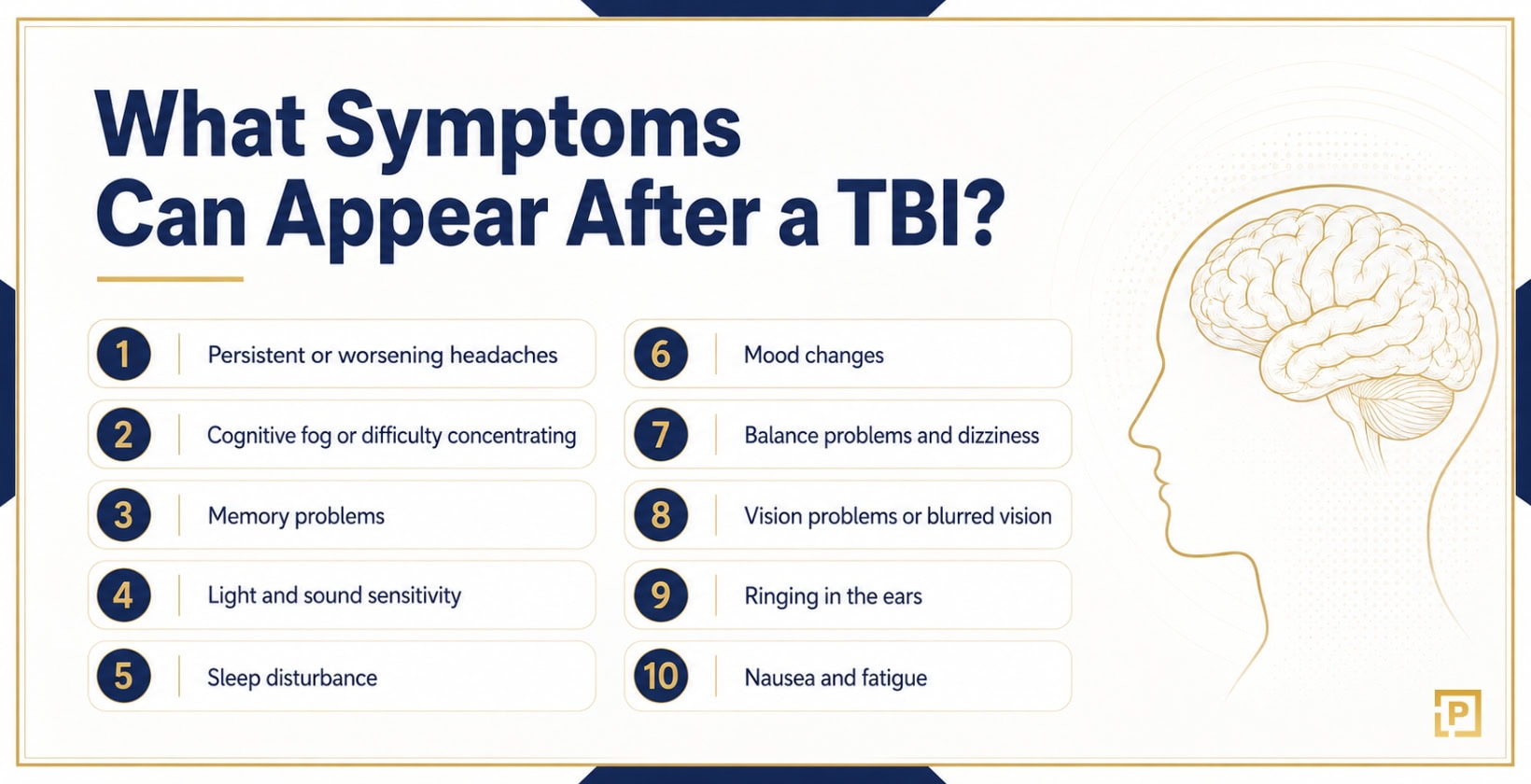
TBI symptoms do not always appear in the emergency room. Mild TBI and post-concussion syndrome (PCS) symptoms may surface hours or days after the incident, and each new symptom that appears after a gap in care gives the insurer an argument that the injury was not caused by the accident. The following symptoms may emerge and escalate over the following weeks. Watch for:
- Persistent or worsening headaches
- Cognitive fog, difficulty concentrating, processing information, or multitasking
- Memory problems, both short-term and long-term recall
- Light sensitivity (photophobia) and sound sensitivity (phonophobia)
- Sleep disturbance, either insomnia or hypersomnia
- Mood changes: irritability, depression, anxiety, or emotional lability
- Balance problems and dizziness
- Vision disturbances or blurred vision
- Ringing in the ears (tinnitus)
- Nausea and fatigue disproportionate to physical activity
If you left the emergency room after an accident without a TBI diagnosis but are experiencing any of these symptoms, see a neurologist immediately and tell them about the accident. The timing of your neurological evaluation affects your legal claim directly. Insurance adjusters use gaps in medical care to argue the injury was not caused by the accident or was not serious enough to warrant treatment.
Diagnostic Tools That Change Case Value
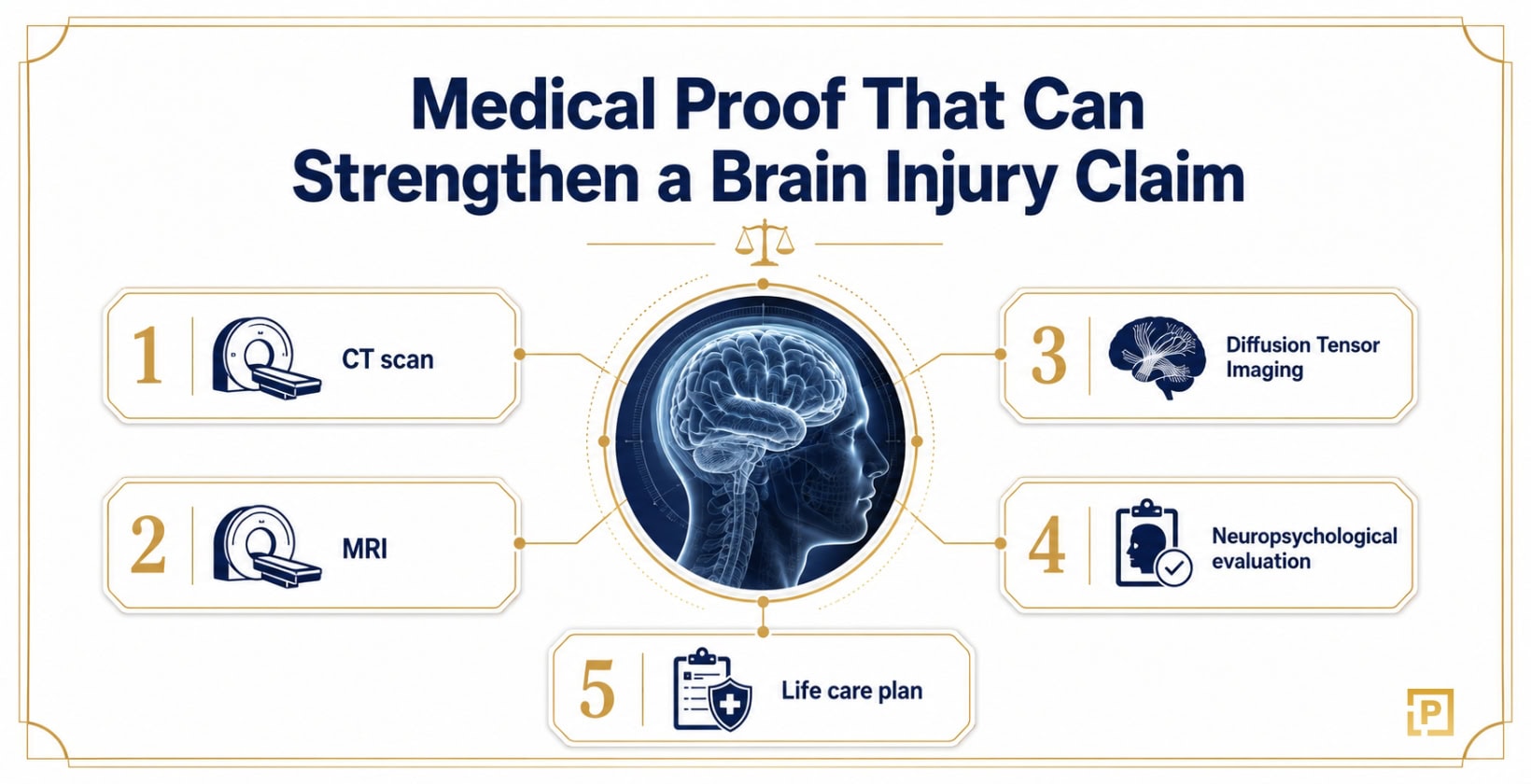
- CT scan: Standard emergency imaging; detects acute bleeds, skull fractures, and large contusions. Does NOT detect mild TBI or axonal injury.
- MRI: More sensitive than CT. A 3T MRI can detect contusions, small hemorrhages, and structural changes that CT misses.
- Diffusion Tensor Imaging (DTI): Diffusion tensor imaging (DTI) is an advanced MRI technique that maps white matter tract integrity. It is the best available tool for objectively documenting diffuse axonal injury (DAI) and the micro-structural damage underlying post-concussion syndrome. DTI findings correlate with neuropsychological deficits and are increasingly accepted by California courts to establish the objective basis of mild TBI claims.
- Neuropsychological evaluation: A battery of standardized cognitive tests administered by a licensed neuropsychologist that objectively measures memory, processing speed, executive function, and other cognitive domains. The results provide a detailed cognitive profile that cannot be disputed as merely subjective. In TBI litigation, a strong neuropsychological evaluation often transforms a claim from a soft-tissue settlement range to a seven-figure case.
- Life care plan: A document prepared by a certified life care planner that projects the cost of a TBI victim’s lifetime medical needs, including therapy, medications, in-home assistance, and potential future surgeries. Life care plans are essential for establishing the full economic scope of future damages.
Damages You Can Recover in an Ontario TBI Claim
Traumatic brain injury produces among the most complex and permanent damage in personal injury law, affecting cognition, personality, earning capacity, and daily function simultaneously. California law entitles TBI victims to recover both economic and non-economic damages from the at-fault party. The goal is to place the injured person in the financial position they would have occupied had the injury never occurred.
Economic Damages
- Emergency room and hospital charges from the date of the accident.
- Neurosurgery, neurology, and rehabilitation physician fees.
- Neuropsychological testing and evaluation costs.
- Physical, occupational, speech, and cognitive therapy.
- Future medical care is projected in a life care plan.
- Prescription medications, both current and projected lifetime costs.
- In-home care and personal assistance costs.
- Lost wages from missed work during treatment and recovery.
- Loss of earning capacity, the reduced ability to work at the pre-injury occupation.
- Vocational rehabilitation costs if career retraining is required.
- Transportation to and from medical appointments.
Non-Economic Damages
- Physical pain and suffering, past and future.
- Emotional distress and psychological harm.
- Cognitive impairment, difficulty processing information, reduced memory, and diminished ability to manage daily responsibilities.
- Personality changes that affect family and social life.
- Loss of enjoyment of life, inability to participate in activities before the injury.
- Loss of consortium for a spouse or domestic partner.
In cases where the at-fault party’s conduct was especially reckless, such as a drunk driver or a truck company with known safety violations, California law may permit punitive damages under Civil Code Section 3294.
How Insurance Companies Fight Traumatic Brain Injury Claims
Insurance companies know that TBI cases carry high settlement values. Their response is a systematic effort to minimize, delay, and deny. Understanding their tactics is the first step in neutralizing them.
- Disputing causation with pre-existing conditions: If you have any prior history of headaches, depression, ADHD, sleep problems, or prior head injuries, the insurer’s representative will argue that your current symptoms are pre-existing and not caused by the accident. California’s eggshell skull doctrine establishes that defendants take plaintiffs as they find them. If the accident aggravated a pre-existing condition, the defendant is liable for the full extent of the aggravation.
- Exploiting the invisible injury gap: A normal CT scan is routinely cited as evidence that no brain injury occurred. Sophisticated TBI counsel responds with MRI, DTI, and neuropsychological evidence demonstrating structural and functional damage that CT does not capture.
- Challenging GCS score context: An initial GCS of 14 or 15 at the scene is used to argue that the TBI was minimal. However, initial GCS can be inflated by adrenaline, and the score at the scene does not reflect the full neurological picture that emerges in the days and weeks following the injury.
- Disputing future medical costs: Insurers routinely hire their own medical experts to challenge a life care plan’s projections. We counter with our own certified life care planner, neuropsychologist, and vocational rehabilitation expert whose credentials and methodology will withstand cross-examination.
- Using recorded statements against you: TBI affects the ability to communicate clearly, recall facts accurately, and process complex questions. Insurance representatives are trained to conduct recorded interviews quickly after the accident, before symptoms fully manifest, and before you have legal counsel. A TBI victim who gives a recorded statement inconsistent with later medical evidence can have their claim significantly devalued. Do not give a recorded statement to any insurance company before speaking with an attorney.
- Insurance bad faith and delayed medical authorization: In cases where a TBI victim has concurrent workers’ compensation coverage or insured medical benefits, insurance bad faith in delaying treatment authorization is a serious compounding harm. Delayed access to neurological care allows the insurer to later argue that the failure to receive timely treatment broke the chain of causation.
California Laws Governing TBI Claims in Ontario
Understanding the specific California statutes that govern TBI claims helps injured people protect their rights and act within critical legal deadlines. TBI personal injury lawsuits in Ontario are filed at San Bernardino Superior Court (247 West Third Street, San Bernardino, CA 92415), which handles all personal injury cases arising from collisions and accidents throughout San Bernardino County. Several statutory provisions are particularly important in brain injury cases.
Statute of Limitations: Code of Civil Procedure Section 335.1
California Code of Civil Procedure Section 335.1 establishes a two-year statute of limitations for personal injury claims. Under this rule, you generally have two years from the date of the accident to file a lawsuit. If you miss the statute of limitations deadline, your claim is permanently barred, regardless of how severe your injuries are.
For TBI victims, the statute of limitations interacts with the discovery rule in an important way. The discovery rule provides that the limitations period does not begin until the plaintiff knew or reasonably should have known that they were injured and that the injury was caused by another’s negligence. Because mild TBI and post-concussion syndrome often emerge days or weeks after an accident, and may not be diagnosed for months, a TBI victim who was never told they had a brain injury may have a later accrual date. This is not automatic, and courts apply the rule strictly: consult an attorney as soon as symptoms appear.
California Pure Comparative Fault
California follows the pure comparative fault doctrine, established by the California Supreme Court in Li v. Yellow Cab Co. (1975) and grounded in Civil Code § 1714. This means that even if you were partially at fault for the accident, you can still recover damages; your award is simply reduced proportionally. For example, if you are found 20% at fault for a TBI accident and your total damages are $500,000, you recover $400,000.
Pure comparative fault matters greatly in TBI cases because insurers aggressively argue that plaintiffs contributed to their own injury through speeding, distracted driving, or failing to wear a seatbelt. We build the strongest possible evidence of the defendant’s negligence to minimize any contributory fault finding. We also challenge insurer arguments that your pre-existing condition constitutes contributory negligence, which it does not under California law.
Government Vehicles: Government Code Section 911.2
If your TBI was caused by a vehicle owned or operated by a government agency: a city bus, a county maintenance truck, a school district vehicle, or any other government entity, Government Code Section 911.2 requires you to file a government tort claim within six months of the date of injury. This is not a lawsuit; it is a mandatory administrative claim that must be filed before any lawsuit can proceed. The six-month deadline is strict. Missing it typically eliminates your right to sue the government entity entirely. Contact us immediately if a government vehicle was involved in your accident.
Wrongful Death: Code of Civil Procedure Section 340.3
If a traumatic brain injury results in the victim’s death, surviving family members may have claims under California’s wrongful death statute. Code of Civil Procedure Section 340.3 governs the limitations period for wrongful death claims arising from felony conduct. Wrongful death claims arising from TBI are among the most complex and emotionally demanding cases in personal injury law. [LINK TO BE ADDED: Ontario Wrongful Death Lawyer page]
What to Do After a TBI Accident in Ontario
The steps you take in the days and weeks following a TBI accident directly affect your recovery and your legal claim. Insurance companies move quickly to investigate, record, and interpret facts in their favor.
- Get medical attention immediately, even if you feel fine: Adrenaline masks pain. A normal CT scan does not rule out TBI. Insist on a neurological referral and document any head impact, even if you did not lose consciousness.
- Request a neurological evaluation as soon as symptoms appear. Get cognitive evaluation documented early, before the insurer calls it pre-existing. A neurologist’s notes from day one are far more powerful than records created six months later under pressure from your attorney.
- Document every symptom in a daily journal. Record headaches, cognitive fog, sleep disturbance, mood changes, and any activity you cannot perform as you did before the accident. This personal diary is admissible evidence of non-economic damages.
- Gather your complete medical record from every provider. This includes emergency room records, all neurological evaluation notes, neuropsychological testing results, imaging studies, and pharmacy records.
- Preserve employer records documenting missed work. Obtain written confirmation from your employer of every day missed and its wage equivalent. If your job duties changed because of your injury, document that change in writing.
- Collect statements from family members and coworkers. People who knew you before the accident and observe you now are powerful witnesses to cognitive and personality changes that you may not fully recognize in yourself.
- Do not give a recorded statement to any insurer without counsel. You are not legally required to give a recorded statement to the adverse driver’s insurer. TBI victims who do so before symptoms fully manifest often make statements that contradict their later medical records.
- Contact an attorney before accepting any settlement offer. Early offers are routinely made before the full scope of TBI damages is known. Accepting a quick settlement closes your claim permanently.
Published Case Results
Pérez Law, PC, publishes its case results to provide transparency to prospective clients. The following results are verified and sourced to the firm’s published settlement pages.
- $2,600,000 – Catastrophic Injury to Minor Plaintiff: Pérez Law, PC recovered $2,600,000 for a minor plaintiff in a catastrophic personal injury matter.
- $1,500,000 – T-Bone Collision Causing Rollover: Pérez Law, PC recovered $1,500,000 for a client injured in a T-bone collision that caused a rollover accident. High-impact crash cases like this one are among the most common mechanisms for TBI.
Past results do not guarantee future outcomes. Every case is different.
Why Hire Pérez Law, PC for Your Ontario TBI Case
TBI cases are won or lost on medical evidence, and we know how to build it. Brain injury claims require expert witnesses, advanced imaging, neuropsychological evaluation, and a life care plan. Many personal injury firms handle soft-tissue injuries routinely. TBI cases are different. They demand a team that understands medical science, knows how to retain and prepare the right experts, and has the financial resources to invest in a case that may take two to four years to resolve.
- 27 years of catastrophic injury experience: Ricardo Antonio Pérez has handled catastrophic injury and serious head injury cases since 1998. He knows how insurance companies value and undervalue these claims because he spent years on the other side of the table as a claims adjuster before becoming an attorney.
- Hands-on managing attorney oversight: Ricardo Agustín Pérez (CA Bar #297967, admitted June 28, 2014) directly oversees catastrophic personal injury cases, including those involving TBI. He has helped build cases involving commercial insurance, catastrophic injury, and complex damage projections.
- Contingency fee – we invest in your recovery: TBI cases are complex and long. The contingency fee model means we absorb the cost of expert witnesses, imaging, neuropsychological evaluation, and litigation preparation. You pay no attorney fees unless we recover on your behalf.
- Local Inland Empire roots: We are based at 822 N Euclid Ave, Ontario, CA, not a franchise with a satellite office. We know the freeways where these accidents happen, the hospitals where clients are treated, and the insurance carriers who handle claims in San Bernardino County.
- Bilingual representation: Our team is fully bilingual in English and Spanish. We handle all aspects of your case, intake, medical coordination, demand drafting, and negotiations, in the language you are most comfortable with.
- 4.8 stars across 157+ Google reviews: Our Ontario office holds a 4.8-star rating based on more than 157 Google reviews, reflecting consistent client satisfaction in personal injury and workers’ compensation representation.
What Our Clients Say
Complex cases require attorneys who stay the course. The following reviews come directly from Google-verified clients:
Ricardo Perez is an amazing young man and quite a professional, diligent attorney. He never gave up on my workers compensation claim. Additionally, Monique took care of everything continually following up on my case.
I had an excellent experience with Perez Law handling my injury case. Their team was professional, compassionate, and kept me informed throughout the process. They fought thoroughly for my case and secured a great outcome. I highly recommend them to anyone in need of a dedicated and knowledgeable attorney.
Areas We Serve
Pérez Law, PC represents traumatic brain injury victims throughout San Bernardino County and the broader Inland Empire, including Ontario, Fontana, Rancho Cucamonga, San Bernardino, Chino, Upland, Pomona, Montclair, and communities along the I-10, I-15, and SR-60 corridors. The majority of TBI cases we handle arise from car crashes, truck accidents, and motorcycle collisions on these freeway routes.
Our Ontario office at 822 N Euclid Ave is easily accessible from all major Inland Empire freeways. As a client-first firm, we also offer home visits and remote consultations for clients who cannot travel due to their injuries.
For related practice areas near you, see our Ontario personal injury lawyer page.
Frequently Asked Questions About TBI Claims in Ontario, CA
The following answers are provided for general information only and do not constitute legal advice. Every TBI case is fact-specific. Contact our office for a free evaluation of your individual claim.
How Much Is a TBI Case Worth in California?
There is no standard settlement value for a TBI case. Value depends on the severity of the injury, the strength of the medical evidence, the extent of lost wages and future earning capacity loss, the cost of future care, and the liability coverage available. Mild TBI cases with strong neuropsychological documentation and persistent symptoms have resolved in the six-figure range; severe TBI with documented DAI, life care plan projections, and liability coverage has produced multi-million-dollar results. The single most important factor is the quality of the medical evidence.
What If the CT Scan at the ER Showed Nothing?
A normal CT scan does not rule out TBI. CT imaging does not detect axonal shearing, white matter microstructure damage, or the neurochemical changes underlying post-concussion syndrome. MRI is more sensitive, and diffusion tensor imaging (DTI) can document white matter tract damage that CT and conventional MRI miss. Neuropsychological evaluation provides objective cognitive evidence independent of imaging. Many of the strongest TBI cases are built entirely without CT findings.
How Long Do I Have to File a TBI Lawsuit in California?
Under Code of Civil Procedure Section 335.1, the general statute of limitations for personal injury claims in California is two years from the date of the accident. The discovery rule may extend this deadline if the TBI was not diagnosed promptly. If a government vehicle caused your accident, Government Code Section 911.2 requires a government claim within six months. Contact an attorney immediately; these deadlines are strict.
Can I Still Recover If I Was Partly at Fault?
Yes. California follows pure comparative fault, established by the Supreme Court in Li v. Yellow Cab Co. (1975) and grounded in Civil Code § 1714. You can recover even if you were partially at fault; your award is reduced by your percentage of fault. If you were 25% at fault and your damages are $800,000, you recover $600,000. Insurers routinely overstate a plaintiff’s fault as a negotiating tactic; we analyze the evidence and push back on unfair fault allocations.
What Experts Are Needed in a TBI Case?
Depending on the severity of the injury, a TBI case may require a neurologist, neuropsychologist, life care planner, vocational rehabilitation expert, economist, accident reconstructionist, and biomechanical engineer. We have relationships with qualified experts in each of these disciplines and select them based on credentials, methodology, and ability to communicate complex findings to a jury.
What Does “No Win, No Fee” Mean for a TBI Case?
Pérez Law, PC, handles TBI cases on a contingency fee basis. You pay no attorney fees unless we recover compensation on your behalf. We advance the costs of medical record retrieval, expert witnesses, court filings, and litigation support. Our fee is a percentage of the recovery, as disclosed in your fee agreement. TBI cases are complex and long; the contingency model means we invest in your recovery from day one.
Do I Need a Lawyer If My TBI Was From a Workplace Accident?
Workplace TBI cases involve an important intersection. You may have a workers’ compensation claim against your employer’s insurer AND a personal injury claim against a third party (such as a contractor, equipment manufacturer, or negligent driver). These dual-track claims are complex and time-sensitive. Our firm handles both personal injury and workers’ compensation matters, which allows us to coordinate your recovery strategy across both systems.
Contact an Ontario Traumatic Brain Injury Lawyer Today
Trusted Injury Lawyers. Decades of Experience. Millions Recovered.
A traumatic brain injury changes everything. Your ability to work, your relationships, your sense of self. The legal process that follows should not add to that burden. At Pérez Law, PC, we handle every aspect of your TBI claim so you can focus on recovery.
To start a free case evaluation, call (909) 983-2235 or contact us online. Our office at 822 N Euclid Ave, Ontario, CA 91762 is open 24/7. Toll-free: (877) 622-5888. Se habla español. No win, no fee.
For more information about related personal injury practice areas, visit our personal injury attorneys in California page or speak with us directly.