
Pérez Law, PC represents injured riders throughout San Bernardino County as the Ontario motorcycle accident lawyer families call after serious crashes on the I-10 corridor. Lead attorney Ricardo Antonio Pérez has spent nearly four decades in the injury field, first as a licensed insurance claims adjuster and PI firm manager starting in 1985, then as a California attorney since 1998. That background means he understands exactly how insurers use rider bias to minimize your claim before you even speak to an attorney. Our office is located at 822 N Euclid Ave, Ontario, CA 91762. Call us now at (909) 983-2235. Se habla español. Free case evaluation. Available 24/7. No win, no fee. Our firm has recovered results, including a $1,500,000 recovery from a serious collision. If you were hurt on a California road, you deserve to know your rights before the insurer’s adjuster writes the narrative for you.
Past results do not guarantee future outcomes. Every case is different.
Free consultation; no fee unless we recover. Call (909) 983-2235 or start a free case evaluation. Se habla español.
The Rider Bias Problem: Why Motorcycle Claims Are Different
When a car driver and a motorcyclist collide, the insurance industry’s default posture is that the rider was at fault. Adjusters are trained to probe for speed, lane changes, and inattention on the rider’s part because reducing your comparative fault percentage is the fastest way to reduce the insurer’s payout.
Ricardo Antonio Pérez worked inside that system as a claims adjuster and manager of personal injury firms beginning in 1985, more than a decade before he was admitted to the California Bar. He knows the adjuster’s playbook from the inside. As your Ontario personal injury lawyer, he uses that knowledge to anticipate every argument the opposing insurer will raise and prepare your case before they can spin the narrative against you.
Bias costs riders money. Insurance companies count on unrepresented riders accepting lowball offers because they assume the system is stacked against them. A contingency lawyer has every incentive to fight that bias; we only get paid when you do. That alignment matters.
California Laws That Govern Your Motorcycle Accident Claim
Understanding the statutes that apply to your case is not optional. They are the foundation of every demand letter we write and every argument we make at the negotiating table. The California Vehicle Code (CVC) and related statutes define your rights, your obligations, and the deadlines that govern your claim. Motorcycle accident claims in Ontario are litigated at San Bernardino Superior Court (247 West Third Street, San Bernardino, CA 92415), which handles personal injury cases arising from collisions throughout San Bernardino County.
Lane Splitting: California Vehicle Code § 21658.1
California is the only state in the nation where lane splitting is explicitly legal. After a 2016 amendment to the California Vehicle Code (CVC), lane splitting is explicitly permitted when done safely under CVC § 21658.1. The California Highway Patrol (CHP) publishes guidelines on safe lane splitting at chp.ca.gov.
Here is the problem: insurers routinely use lane splitting against riders even though the conduct is entirely lawful. An adjuster will argue that a rider “contributed to the accident” simply because they were filtering through traffic at the moment of impact. That argument has no legal merit when the rider was operating within the bounds of CVC § 21658.1.
We counter that argument with evidence: dash camera footage from surrounding vehicles, traffic camera recordings, and police report notations about lane positions. If you were lane splitting legally and another driver cut into your lane without signaling, that driver, not you, is the negligent party. See also the California DMV Motorcycle Handbook for the state’s official safety guidelines riders are expected to follow.
Helmet Law: California Vehicle Code § 27803
CVC § 27803 requires all riders and passengers in California to wear a helmet that meets federal safety standards. Wearing a properly fitted, compliant helmet protects your life, and it protects your claim. A well-documented helmet reduces the defense’s ability to argue that you aggravated your own head injuries.
If you were not wearing a helmet at the time of the crash, that failure does not automatically bar you from recovering compensation in California. However, the defense may raise it as a comparative negligence argument, claiming your injuries would have been less severe with helmet use. Our team addresses this argument head-on by working with medical experts to establish the true cause and severity of your injuries, independent of helmet use.
Pure Comparative Negligence: California Civil Code § 1714
California follows a pure comparative negligence system as established in Li v. Yellow Cab Co. (1975) 13 Cal.3d 804. This means you can recover compensation even if you are found partially at fault for the accident; your award is simply reduced by your percentage of fault.
Here is a plain-language example: a jury finds you were 20 percent at fault because you were lane splitting at the time of the crash, and the driver who cut into your lane was 80 percent at fault. If your total damages are $500,000, you recover $400,000, reduced by your 20 percent share. You are not barred from recovery. You collect the portion of damages that belongs to you.
This rule is critical for motorcycle cases where insurers aggressively inflate the rider’s percentage of fault to drive down the payout. Every percentage point matters. Our job is to keep your fault allocation as low as the evidence supports.
Statute of Limitations: Code of Civil Procedure § 335.1
The statute of limitations for personal injury claims in California is two years from the date of the accident. Code of Civil Procedure § 335.1 sets this deadline. If you miss it, you permanently lose your right to file a lawsuit, regardless of how serious your injuries are or how clearly the other driver was at fault. Do not wait. Evidence disappears, witnesses forget details, and surveillance footage is deleted within days or weeks of an accident.
There are situations where this deadline can be shorter or longer, depending on the facts of your case. That is why we recommend calling us as soon as possible after any crash.
Government Claims Deadline: Government Code § 911.2
If your accident was caused or worsened by a road defect, a pothole, damaged pavement, missing signage, or poor road design, a government agency may share liability. Government Code § 911.2 requires you to file an administrative claim with the responsible agency within six months of the injury date. This deadline is separate from and much shorter than the two-year statute of limitations for private parties. Missing it can bar your claim against the government entity entirely.
On roads like the I-10 through Ontario, SR-60, and portions of Route 66, road maintenance defects are a documented hazard for motorcyclists. If road conditions contributed to your crash, we will investigate that liability avenue as part of your case.
Permissive Use and Owner Liability: Vehicle Code § 17150
Vehicle Code § 17150 makes a vehicle owner liable for injuries caused by a driver who operates that vehicle with the owner’s permission. If the driver who hit you was operating a vehicle they did not own, a borrowed car, a fleet vehicle, or an employer-owned truck, the owner or the owner’s insurer may be a second source of recovery. We identify every available insurance layer as part of our investigation.
Common Causes of Motorcycle Accidents in Ontario and the Inland Empire
The Inland Empire road network, the I-10, I-15, SR-60, and the Route 66 corridor running through Ontario, is one of the highest-traffic riding environments in Southern California. Understanding the cause of your crash is the first step to building a successful claim.
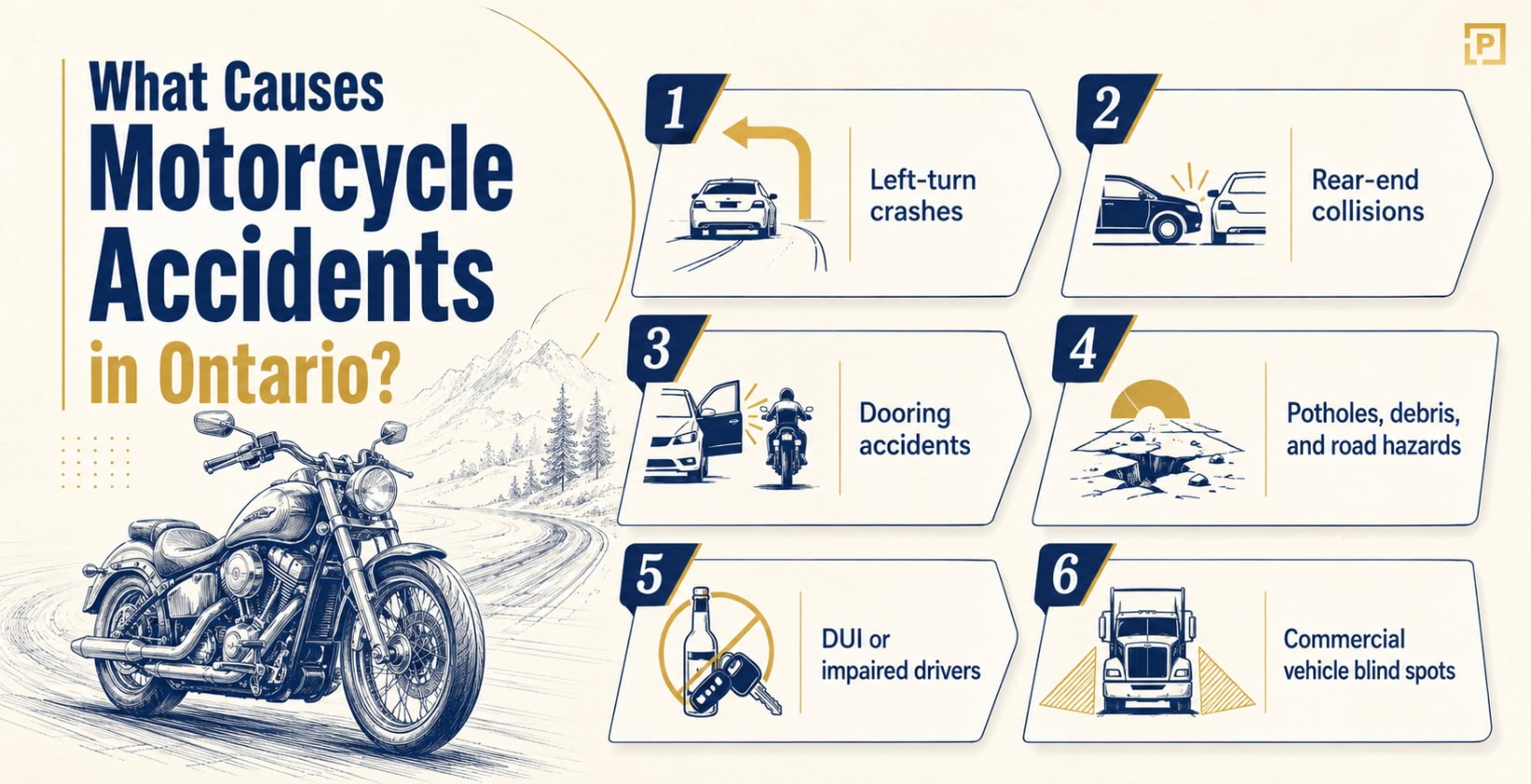
- Left-Turn Crashes: Left-turn collisions are the most common type of motorcycle accident in California. A driver turns left through an intersection and fails to yield to an oncoming motorcycle. The driver typically claims they “didn’t see” the rider. Insurers then use the rider’s smaller profile to shift blame. We counter this with police reports, intersection camera footage, and accident reconstruction.
- Rear-End Collisions: Distracted and tailgating drivers cause rear-end crashes that throw riders from their bikes. At freeway speeds on the I-10, these crashes produce catastrophic injuries. A rear-end collision where you were fully stopped or moving with traffic strongly supports a finding that the rear driver was at fault, though every case turns on its specific facts.
- Dooring: A driver or passenger opens a car door into a rider’s path without checking for approaching motorcycles. Dooring injuries range from broken bones to traumatic brain injury (TBI), depending on speed and impact. Urban stretches of Ontario Boulevard and Holt Avenue present this risk.
- Road Hazards and Government Liability: Potholes, deteriorated lane markings, debris, and oil slicks are far more dangerous to motorcycles than to passenger cars. If a road defect caused or contributed to your crash, the government agency responsible for maintaining that road may be liable. The six-month Government Code § 911.2 deadline applies in these cases, which is why early investigation matters.
- DUI and Impaired Drivers: Drunk and drug-impaired drivers are a documented danger on Inland Empire roads, particularly on I-15 weekend nights. According to NHTSA motorcycle crash statistics, 40 percent of motorcycle riders who died in single-vehicle crashes in 2024 were alcohol-impaired. When an impaired driver causes your accident, we pursue both compensatory and punitive damages.
- Commercial Vehicle Blind Spots: Trucks and large commercial vehicles operating in and around Ontario’s distribution and warehouse corridor have wide blind spots that swallow motorcycles entirely. If a commercial driver merged, turned, or changed lanes without confirming their lane position, the driver’s employer may share liability. See our Ontario truck accident lawyer page for more on commercial vehicle liability.
Common Motorcycle Accident Injuries
Motorcycles offer no protective cage, no airbags, and no crumple zones. When a rider goes down, whether from a direct collision, a fall, or a road hazard, the human body absorbs the full force of the impact. The injuries that result are frequently catastrophic and permanently life-altering.
- Road Rash: Road rash is one of the most underestimated injuries in motorcycle crashes. When skin contacts asphalt at speed, the friction creates deep tissue damage that can require skin grafting, carries a high infection risk, and leaves permanent scarring. Severe road rash is a serious injury with high medical costs.
- Broken Bones and Fractures: Broken bones follow predictable patterns. Riders instinctively extend their arms to break a fall, resulting in fractured wrists, arms, and clavicles. Impact with vehicles or road surfaces causes femur fractures, pelvic injuries, and rib breaks. Many fractures require surgical intervention, hardware implantation, and extended physical therapy.
- Traumatic Brain Injury (TBI): Traumatic brain injury (TBI) is one of the leading causes of motorcycle fatality and permanent disability. Riders injured in high-speed crashes on the I-10 and I-15 corridors are frequently transported to Arrowhead Regional Medical Center (400 N Pepper Ave, Colton, CA 92324), San Bernardino County’s Level I trauma center. A documented trauma center evaluation, including a GCS assessment, is foundational evidence in any serious motorcycle injury claim. Even a helmet-wearing rider can sustain a concussion or severe TBI from the rotational forces of a crash. TBI symptoms, including cognitive impairment, personality changes, chronic headaches, and memory loss, can take weeks to manifest. Early neurological documentation is critical. See our Ontario traumatic brain injury lawyer page for TBI-specific claim strategy. According to the NHTSA, motorcyclists are significantly more likely than passenger vehicle occupants to sustain fatal head injuries in a crash.
- Spinal Cord Injury: High-impact motorcycle crashes can fracture vertebrae and compress or sever the spinal cord, producing partial or complete paralysis. Spinal cord injuries are among the most expensive injuries to treat and the most devastating in terms of long-term quality of life. The economic damages alone in a serious spinal case can exceed seven figures.
- Internal Bleeding and Organ Damage: Blunt abdominal trauma from a crash impact can damage the liver, spleen, kidneys, and other organs without any external sign of injury. Internal bleeding is a medical emergency that requires immediate surgical intervention. If you walked away from a crash feeling “okay” and then felt worse hours later, seek emergency care immediately.
What to Do After a Motorcycle Accident in Ontario
Protect your bike, your gear, your record, before the insurer spins the narrative. The steps you take in the first hours and days after a crash will directly affect the strength of your claim. The insurer’s adjuster may be assigned to your case within 24 hours. You need to be ready.
- Call 9-1-1 and stay at the scene. A police report is essential documentation. Give your account of events factually, but do not speculate or admit fault at the scene.
- Photograph everything before your bike is moved. Skid marks, road surface conditions, debris, the other vehicle’s position, traffic signals, weather, and your injuries. These images may be the only record of conditions that existed at impact.
- Get witness names and phone numbers immediately. Bystander testimony is often the deciding factor when the other driver disputes your account. Get names and phone numbers immediately.
- Seek immediate medical care. Even if you feel fine, go to the emergency room or urgent care. TBI and internal injuries do not always present symptoms immediately. A gap in medical documentation is one of the most damaging things for your claim.
- Do not give a recorded statement to any insurer. Not your own. Not the other driver’s. You are not legally required to give a recorded statement, and anything you say will be used to minimize your claim. Tell them your attorney will be in touch.
- Keep your gear exactly as it is. Do not wash, repair, or discard your helmet, jacket, gloves, or boots. Your gear is physical evidence of the impact and your protective equipment choices at the time of the crash.
- Document your road to recovery. Keep a daily journal. Note your pain levels, activities you cannot perform, sleep disruption, and emotional distress. This documentation supports your non-economic damages claim.
Evidence disappears fast. Traffic camera footage is often overwritten within 72 hours. Skid marks fade with weather and traffic. We will investigate immediately; call us the same day if you can.
Evidence That Strengthens Motorcycle Accident Claims
California motorcycle accident cases are won and lost on evidence. The more documentation we gather early, the stronger your position at the negotiating table and in court.
Critical Evidence We Seek Immediately
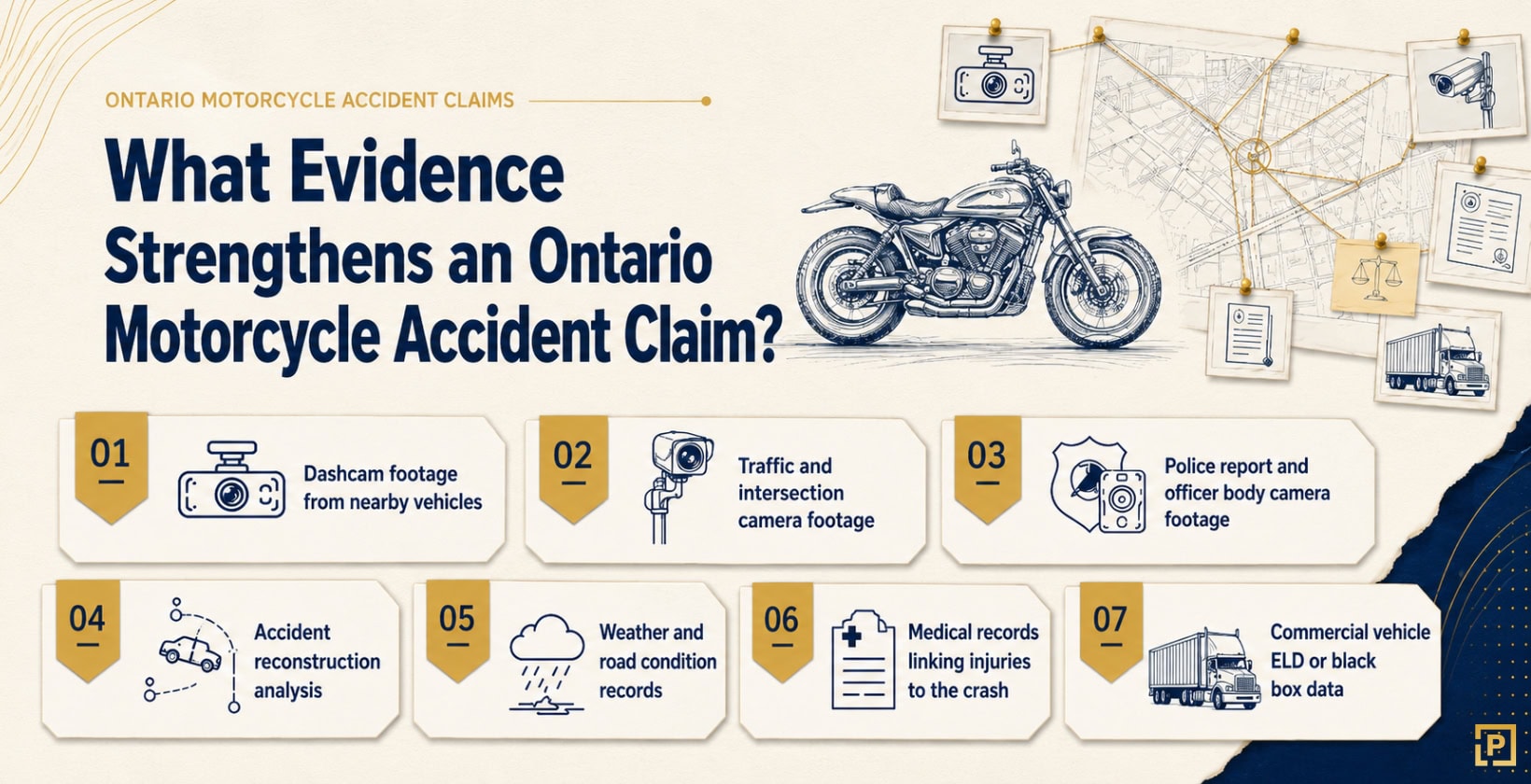
- Dashcam footage from the at-fault vehicle or surrounding vehicles. Many commercial trucks in Ontario carry forward and rear cameras.
- Traffic and intersection camera footage from Caltrans, the city of Ontario public works, and private businesses along the crash corridor.
- Police report and officer body camera footage, including the responding officer’s observations about road conditions and vehicle positions.
- Accident reconstruction analysis by a qualified expert who can determine speed, impact angles, and lane positions from physical evidence.
- Weather and road condition records for the date and location of the crash.
- Road maintenance records from Caltrans or the city of Ontario, if road defects were a factor. These records document prior complaints and known hazard conditions.
- Medical records establishing the immediate connection between the crash and your injuries are critical for countering insurer claims that injuries are “pre-existing.”
- Electronic logging device (ELD) and black box data from commercial vehicles must be preserved by legal hold immediately, as data can be overwritten within 30 days.
Who Can Be Held Liable for Your Motorcycle Accident?
Many motorcycle accident claims involve more than one liable party. Identifying every source of liability means identifying every insurance policy and every dollar of potential recovery. We investigate all of the following:
- The at-fault driver: The primary defendant in most crashes. Their auto liability insurance is the first coverage source we pursue.
- The driver’s employer: If the at-fault driver was operating a vehicle in the course of their employment at the time of the crash, their employer may be vicariously liable. Commercial vehicle crashes near Ontario’s warehouse corridor frequently implicate this doctrine.
- The vehicle owner: Under Vehicle Code § 17150, a vehicle owner who permits another to drive their vehicle shares liability for accidents that the driver causes.
- A government agency: If road design, maintenance failures, or missing signage contributed to the crash, the responsible agency is potentially liable. The six-month administrative claim deadline under Government Code § 911.2 applies.
- A vehicle or parts manufacturer: If a defective component, a tire blowout, brake failure, or throttle malfunction caused or contributed to the crash, the manufacturer faces product liability exposure.
Identifying every responsible party matters not only for maximizing your recovery but for protecting you if the primary defendant has inadequate insurance.
Dealing With Insurance Companies After a Motorcycle Crash
Insurers treat motorcycle claims differently from car claims, and the difference is not in your favor. Rider bias is a documented industry phenomenon. Adjusters are trained to probe for rider error, to offer quick lowball settlements before you understand the full extent of your injuries, and to use your statements against you.
- Uninsured and Underinsured Motorist Coverage: California requires that all drivers carry minimum liability coverage, but many do not, and the minimum is often far below the cost of serious motorcycle injuries. Uninsured motorist (UM) coverage protects you when the at-fault driver has no insurance. Underinsured motorist (UIM) coverage provides additional compensation when the at-fault driver’s policy limits are insufficient to cover your damages. We review your own policy for UM/UIM coverage as part of every case evaluation.
- Recorded Statements and Early Settlement Offers: Never give a recorded statement to the other driver’s insurer before speaking with an attorney. Never accept a first offer without understanding the full extent of your injuries, future medical costs, and lost earning capacity. A settlement that seems reasonable on Day 10 can prove grossly inadequate six months later when you learn you need surgery or long-term rehabilitation.
- How We Handle the Insurer: When you retain Pérez Law, PC, we handle all communication with every insurer from that point forward. We send a representation letter immediately, placing the insurer on notice and requiring all communications to go through us. We preserve evidence by sending spoliation letters to the at-fault party and their insurer. We build your full damage picture before we make a demand.
What Compensation Can Motorcycle Accident Victims Recover?
California law allows injured motorcycle riders to seek full compensation for both economic and non-economic losses. The damages available in your case depend on the severity of your injuries, your income before and after the crash, your medical treatment needs, and the evidence we build.
Economic Damages
- Emergency room treatment, surgeries, hospitalization, and ongoing specialist care
- Future medical costs: physical therapy, rehabilitation, assistive devices, long-term nursing care
- Lost wages for all time missed from work during recovery
- Loss of future earning capacity if your injuries prevent you from returning to your pre-accident occupation
- Motorcycle repair or replacement, and protective gear damaged in the crash
- Out-of-pocket expenses: transportation to medical appointments, prescription medications, home modifications
Non-Economic Damages
- Physical pain and suffering from your injuries and recovery
- Emotional distress, anxiety, and post-traumatic stress
- Loss of enjoyment of life, activities, and hobbies you can no longer pursue
- Loss of consortium for your spouse or domestic partner
- Permanent scarring and disfigurement from road rash or surgical procedures
Wrongful Death Damages
If a motorcycle accident results in the death of a loved one, surviving family members may pursue a wrongful death claim under California law. This includes funeral and burial expenses, lost financial support, and loss of companionship.
Mr. Perez and his team are phenomenal! We were involved in a multi-vehicle accident… Mr. Perez always took the time to answer my questions and concerns even if he was out of the office. I received more than I thought was possible.
Published Case Results
At Pérez Law, PC, we publish our results because transparency is part of how we earn your trust. Every result listed here is verifiable on our website.
Our attorneys have recovered over $4.1 million for clients in serious injury cases, including complex multi-party claims and catastrophic injuries. The legal complexity of these cases demands exactly this level of experience. View the detailed results below:
- $1,500,000 Recovery: T-bone collision causing a rollover accident. Serious injuries. Complex multi-party claim.
- $2,600,000 Recovery: Catastrophic injuries sustained by a minor plaintiff.
Past results do not guarantee future outcomes. Every case is different. View our full case results page.
Why Hire Pérez Law, PC as Your Ontario Motorcycle Accident Attorney
Rider bias is real. We know the counter-arguments. Ricardo Antonio Pérez spent years on the other side of these negotiations before he became an attorney. He founded Pérez Law, PC in 1998 with a single mission: to fight for California injury victims with the inside knowledge of how the insurance industry operates.
- Adjuster background, not just courtroom theory. Ricardo Antonio Pérez’s 40 years in injury law include direct experience as a licensed claims adjuster and PI firm manager. He knows every tactic the insurer will use against you.
- True contingency representation. No win, no fee. You pay nothing unless we recover for you. We advance all case costs. There is no financial risk to finding out what your case is worth.
- Bilingual English/Spanish service. Our team serves clients in Spanish from the first call through settlement. Se habla español.
- 24/7 availability for case evaluations. Motorcycle accidents do not happen on a schedule. Neither do we. Call (909) 983-2235 any time.
- Family firm with Inland Empire roots since 1998. We represent riders injured in Ontario, Rancho Cucamonga, Fontana, Chino, Upland, Montclair, Pomona, and San Bernardino, along with riders on the I-10, I-15, SR-60, and Route 66 corridor.
- Personal Injury Department Manager and experienced PI case managers. Axel Rivera leads our PI department, supported by a dedicated team including Daisy Cervantes, Alexis Palacios, and Suhey Ávila, who coordinate treatment, property damage, and case communication from intake through demand.
We are also personal injury attorneys in California handling the full spectrum of serious injury cases, including car accidents, truck accidents, wrongful death, and traumatic brain injury.
Their team was professional, compassionate, and kept me informed throughout the process. They fought thoroughly for my case and secured a great outcome.
Motorcycle Riding in Ontario and the Inland Empire
Ontario sits at one of the busiest freeway interchanges in the Inland Empire. The I-10 and I-15 intersect just north of downtown, and the SR-60 feeds traffic from Pomona and Los Angeles County into the corridor daily. The California Highway Patrol (CHP) Inland Division documents motorcycle crash data across San Bernardino County, and the numbers confirm what riders already know: this corridor sees serious crashes.
Route 66 through Ontario and Rancho Cucamonga draws recreational riders year-round. Mountain roads toward the San Gabriel Mountains and Cajon Pass are popular weekend routes. Every one of these corridors has documented crash risk from distracted drivers, road hazards, and commercial vehicle traffic concentrated around the area’s massive distribution and warehouse zone.
If you were injured on any surface street in San Bernardino County, you may have a viable personal injury claim. The specific road conditions, traffic control measures, and government maintenance records for the crash location are part of what we investigate.
We serve riders across the region: Ontario, Rancho Cucamonga, Fontana, Chino, Upland, Montclair, Pomona, and San Bernardino. For Ontario residents injured in slip and fall accidents at commercial properties or public spaces throughout the Inland Empire, see our Ontario slip and fall lawyer page for premises liability guidance specific to these claims.
Motorcycle Accident FAQ: Answers for Ontario Riders
What Should I Do Immediately After a Motorcycle Crash in Ontario?
Stay at the scene, call the police, photograph everything before any vehicle is moved, collect witness contact information, seek medical care the same day, even if you feel fine, and call an attorney before giving any statement to an insurer. The first 24 hours are critical to your claim.
Can I Recover Compensation If I Was Lane Splitting When the Accident Happened?
Yes. Lane splitting is legal in California under CVC § 21658.1. An insurer may try to use your lane splitting to inflate your percentage of fault under California’s comparative negligence rules, but legal lane splitting does not make you negligent per se. If the other driver’s negligence caused the crash, an unsignaled lane change, inattention, or failure to yield, you are entitled to recover your damages reduced only by your actual percentage of fault.
I Wasn’t Wearing a Helmet. Can I Still File a Claim?
Yes. Not wearing a helmet does not bar you from recovering compensation in California. The defense may argue that your head or facial injuries would have been less severe with helmet use, and a jury can reduce your non-economic damages accordingly. But helmet use is not a condition of your right to recover for injuries caused by another person’s negligence.
How Long Do I Have to File a Motorcycle Accident Lawsuit in California
The statute of limitations under Code of Civil Procedure § 335.1 is two years from the date of the accident for most personal injury claims. If a government entity is involved, such as a city or county responsible for road maintenance, you must file an administrative claim within six months under Government Code § 911.2. Missing either deadline typically bars your claim permanently.
What If the Driver Who Hit Me Is Uninsured?
If the at-fault driver has no insurance, you may be able to file a claim under your own uninsured motorist (UM) coverage if you purchased it. If the driver has insurance but their limits are too low to cover your damages, your underinsured motorist (UIM) coverage can provide additional recovery. We review your full insurance profile as part of every case evaluation.
What Is My Motorcycle Accident Case Worth?
There is no honest answer to this question without knowing your injuries, your treatment course, your income, and the available insurance coverage. What we can tell you is that insurers are motivated to settle quickly and low before you understand your full damages. Do not accept any offer before consulting an attorney. Free case evaluation at (909) 983-2235.
How Does the Contingency Fee Work?
Pérez Law, PC represents motorcycle accident clients on a pure contingency basis. You pay no attorney fee unless we recover for you. We advance all case costs. If we do not win, you owe us nothing. Our fee is a percentage of the recovery, disclosed clearly in writing before you sign anything.
Do You Handle Motorcycle Accident Cases That Result in Wrongful Death?
Yes. If a motorcycle accident results in the death of a loved one, surviving family members may pursue a wrongful death claim. These cases are handled with the highest sensitivity by our team.
Related Practice Areas
Every serious accident has multiple dimensions. If your motorcycle accident involved a commercial truck, a traumatic brain injury, or multiple vehicles, we have dedicated practice areas covering those angles:
- Ontario Car Accident Lawyer: Multi-vehicle crash claims and insurer negotiation strategy
- Ontario Truck Accident Lawyer: Commercial vehicle liability, black box evidence, employer vicarious liability
- Ontario Traumatic Brain Injury Lawyer: Motorcycle riders face a higher TBI risk than any other road user.
- Ontario Personal Injury Lawyer (hub): Overview of all personal injury services in Ontario, CA
Contact an Ontario Motorcycle Accident Lawyer Today
You were injured by someone else’s negligence. You deserve an attorney who knows how the insurance industry operates from the inside, who will investigate your crash immediately, and who will fight to recover every dollar your case supports.
Pérez Law, PC is located at 822 N Euclid Ave, Ontario, CA 91762. Start a free case evaluation online, or call our Ontario office directly at (909) 983-2235 or toll-free (877) 622-5888. Available 24/7. No win, no fee.
Se habla español.
Past results do not guarantee future outcomes. Every case is different.