
Holt Avenue, Garey Avenue, and Mission Boulevard carry some of the densest foot traffic in Los Angeles County, and the properties along those corridors. Grocery stores, shopping centers, apartment complexes, and warehouses don’t always get the upkeep California law requires. The National Safety Council recorded more than 8.8 million ER visits from falls in 2023 alone. That number reflects what happens when property owners let hazards sit. If you were hurt at a Mission Boulevard shopping center, at the Fairplex, or at an apartment complex near Cal Poly Pomona, California’s premises liability law gives you the right to hold the owner responsible.
Cases filed at Los Angeles County Superior Court, Pomona Courthouse South, require a specific evidence record: incident reports, property inspection logs, lighting assessments, and surveillance footage that most property owners will deny exists unless compelled. If you are searching for a slip and fall lawyer in Pomona, Pérez Law, PC builds that record from the day you call. Our office is located at 522 W Holt Ave, less than a mile from the Pomona Courthouse South.
Attorney Ricardo Antonio Pérez (CA Bar #194646) has spent nearly four decades in injury law (attorney since 1998), including premises liability cases throughout San Bernardino and Los Angeles counties. As a Pomona personal injury attorney with a physical office in the city, Ricardo Antonio Pérez knows the properties, the courts, and the insurance carriers operating in this market.
Call (909) 622-1071 for a free case evaluation, available 24/7.
$2,600,000. A Minor Plaintiff. A Major Retailer That Thought Otherwise.
Pérez Law, PC secured a $2,600,000 recovery in a personal injury matter involving a minor plaintiff who suffered a facial injury in an incident connected to a major retailer. Facial injuries to minors carry immediate medical costs, the likelihood of long-term treatment, and consequences that follow a child through their development. The firm pursued full compensation for all of it.
Property owners and major retailers carry legal teams and insurance resources from day one. This result reflects what aggressive, evidence-driven representation looks like when the other side has every advantage.
View the case result. Past results do not guarantee future outcomes. Every case is different.
What Makes a Slip and Fall Claim Valid in California?
A valid slip and fall claim in California requires proof that the property owner owed you a duty of care, that the owner breached that duty by creating or failing to correct a dangerous condition, that the breach caused your fall and injuries, and that you suffered compensable damages as a result. Each of these four elements, duty, breach, causation, and damages, must be supported by evidence.
California Civil Code Section 1714 establishes the foundational duty of care: every person is responsible for injuries caused by their own lack of ordinary care or skill in managing their property. In plain terms, a property owner must use reasonable care to keep the premises in a safe condition. That duty applies whether the dangerous condition was created by the owner, an employee, or was simply allowed to persist after the owner knew or should have known about it.
Premises liability cases require close attention to how and where the fall occurred, what the owner knew before the fall, and what evidence was preserved in the first hours after the injury. As your Pomona personal injury lawyer, Pérez Law, PC builds the evidence record that supports each element of your claim.
What Duty of Care Did the Property Owner Owe You?
California does not apply different legal standards based on whether you were a customer, a guest, or a visitor at the time of your fall. Under Rowland v. Christian (1968), California abolished the old invitee, licensee, and trespasser categories and replaced them with a single standard: did the property owner exercise reasonable care under the circumstances? That standard is grounded in Civil Code Section 1714, which holds every person responsible for injuries caused by their failure to use ordinary care in managing their property.
In practice, the circumstances matter. A grocery store on Holt Avenue that is open to the public, charging customers, and profiting from foot traffic faces a higher practical burden of reasonable care than a private homeowner hosting a dinner party. A property that regularly attracts the public is expected to inspect more frequently, correct hazards more promptly, and post warnings more consistently than a property with limited visitor access. The standard is the same; the evidence of what was reasonable under those specific conditions is what changes.
For the vast majority of Pomona slip and fall clients, people injured at retail stores, restaurants, shopping centers, apartment common areas, and commercial properties, reasonable care required the owner to inspect regularly, identify dangerous conditions, and either correct them or warn visitors before someone was hurt. Whether the owner met that standard is the central question in your case.
Notice Doctrine: What the Property Owner Knew or Should Have Known
Even when a dangerous condition is established, the property owner is not automatically liable. California law requires the injured party to prove that the owner had notice of the dangerous condition, either actual notice or constructive notice, before the fall occurred.
Actual Notice.
Actual notice exists when the owner or their employees knew about the specific hazard before the fall. A wet floor that a store employee mopped but failed to mark with warning signs, a broken step that a property manager noted in a maintenance log but did not repair, or a pothole that residents had already reported to a landlord: these are examples of actual notice. If the owner knew and did nothing, liability is clear.
Constructive Notice.
Constructive notice is more nuanced and far more common in contested slip and fall claims. It exists when the dangerous condition was present long enough that a reasonably careful owner exercising ordinary inspection and maintenance would have discovered and corrected it. The key question is: how long was the hazard there? A spill that occurred two minutes before a fall is very different from a spill that has been spreading for two hours. Courts and juries look at the nature of the condition, the owner’s maintenance routine, whether employees circulated the area, and whether the condition would have been visible during a routine inspection.
In Pomona retail stores and restaurants, the constructive notice argument often turns on the store’s own inspection and cleaning logs. Failure to maintain regular inspection records can itself become evidence of negligence.
Comparative Negligence and Shared Fault Under California Law
California follows a pure comparative negligence rule, meaning an injured person can recover compensation even if they were partially at fault for the fall. The amount recovered is reduced by the percentage of fault attributed to them.
A concrete example: suppose you slipped on an unmarked wet floor at a Pomona grocery store and suffered injuries resulting in $100,000 in total damages. If a jury finds that you were 30 percent at fault for not watching where you were walking, you would recover $70,000. California imposes no fault threshold below which a plaintiff cannot recover, which distinguishes it from states that bar recovery once the plaintiff’s fault exceeds 50 percent.
Fault percentages are negotiated and, if the case proceeds to litigation, determined by a jury at the Los Angeles County Superior Court, Pomona Courthouse, 400 Civic Center Plaza, Pomona, CA 91766. Insurance adjusters and defense attorneys routinely attempt to assign as much fault as possible to the injured person to reduce the payout. An experienced slip and fall lawyer who documents the scene, challenges inflated fault assignments, and presents the case clearly can be the difference between a partial recovery and a full one.
Government Property Falls in Pomona: The 6-Month Deadline That Changes Everything
IMPORTANT: If your slip and fall occurred on government-owned property, including a city sidewalk in Pomona, a parking lot owned by the City of Pomona, a public park, a state building, or any other government-maintained premises, California Government Code Section 911.2 imposes a 6-month deadline to file a government tort claim. This deadline is strictly enforced and is completely separate from the standard 2-year statute of limitations that applies to private property claims.
The 6-month clock begins on the date of the incident. Missing this deadline typically bars your claim permanently, regardless of how strong the evidence is. Six months passes faster than most injury victims expect, especially when they are focused on recovery, medical appointments, and getting back to work. If there is any chance your fall occurred on government or city-maintained property, treating the deadline as an emergency is the only safe approach.
Common government property fall locations in Pomona include city sidewalks maintained by the City of Pomona, public parking structures, parks operated by the City’s Parks and Recreation Department, Pomona Unified School District facilities, California state buildings, and public transit stops and facilities. The analysis of whether a specific property is government-owned requires investigation: a property may look private but be under government control, or vice versa.
Under California Code of Civil Procedure Section 335.1, claims against private parties must be filed within 2 years of the date of injury. For most slip and fall cases in Pomona involving private retailers, restaurants, apartment buildings, or commercial property, this 2-year window applies. Even so, the earlier a claim is investigated and documented, the stronger the evidence record will be.
Do not wait to find out which deadline applies. Call Pérez Law, PC at (909) 622-1071 as soon as possible. Free case evaluation, 24/7.
Common Slip and Fall Locations in Pomona, CA
Not every Pomona property carries the same risk profile. Here are the locations the firm sees most often and what typically drives liability at each one.
- Retail Stores and Shopping Centers. A spill in the produce aisle at a Holt Avenue grocery store and a cracked entrance mat at the Pomona Marketplace are different hazards, but the same legal standard applies to both: retailers owe customers a duty of reasonable care and are expected to inspect throughout operating hours, not just at opening.
- Restaurants and Food Service Establishments. Grease, water, and spilled food near service areas and restrooms create persistent slip hazards in Pomona restaurants and fast-food locations. Staff are often aware of high-hazard zones but may fail to place warning signs or clean promptly. When a customer falls, the operator’s internal cleaning schedule and employee training records become key evidence.
- Apartment Complexes and Residential Property. Landlords and property management companies owe tenants, and their guests, a duty to maintain common areas and respond promptly to reported hazards: broken stairways, defective handrails, unlit walkways, and deteriorated flooring don’t fix themselves, and a maintenance request that went unanswered is often the strongest notice evidence in the file.
- Parking Lots and Parking Structures. Cracked pavement, unmarked elevation changes, and inadequate lighting create fall risks that California premises liability law covers equally with indoor hazards.
- Sidewalks and Public Walkways. Whether a buckled sidewalk near Cal Poly Pomona is the responsibility of the adjacent property owner or the City of Pomona determines which legal framework and which filing deadline applies, and that distinction must be investigated before either clock runs out.
Injured at one of these locations in Pomona? Call (909) 622-1071 or start a free case evaluation online. No fee unless we recover.
What to Do Immediately After a Slip and Fall in Pomona
What you say, sign, and document in the first hours after a fall can be used against you later. Most people don’t know that. The evidence record in a premises liability case starts at the scene, before an attorney is involved, before an adjuster arrives, before anyone has decided whether the case has value.
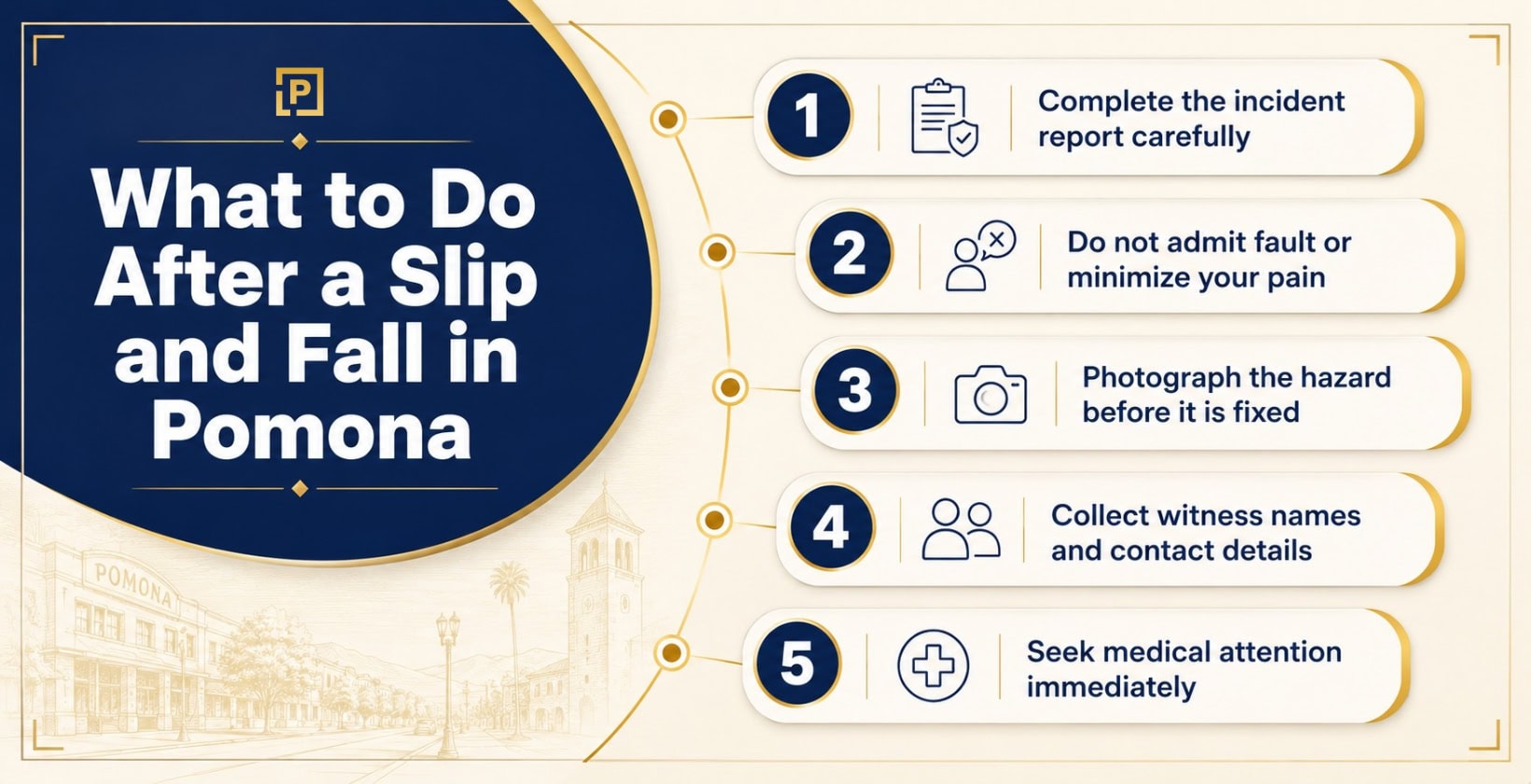
- Complete the incident report, but carefully. When you fall at a store, restaurant, or managed property, staff will often ask you to complete an incident report. You should document that the fall occurred, but you should not speculate about fault, minimize your pain, or sign any document that releases the property owner from liability. Describe what happened factually. Do not accept offers of immediate cash payments in exchange for signing a release.
- Be careful with what you say. Avoid statements such as ‘I wasn’t looking where I was going,’ ‘I should have seen it,’ or ‘I’m fine, it’s not serious.’ These phrases, even if meant casually, become evidence of comparative fault. Report the fall, but reserve any discussion of fault or injury extent for your attorney.
- Document everything before you leave. Photograph the exact location of the fall from multiple angles. Capture the hazardous condition, the spill, the broken surface, the missing warning sign, before staff have the opportunity to correct it. Collect the names and contact information of any witnesses. Request and keep a copy of any incident report you complete.
- Seek medical attention immediately. California insurance adjusters heavily scrutinize gaps between the date of injury and the first medical visit. A delay in seeking care, even one or two days, is used as evidence that the injuries were not serious or were caused by something other than the fall. See a doctor the same day or the next day, regardless of whether symptoms seem severe. Pomona Valley Hospital Medical Center (PVHMC), 1798 N Garey Ave, Pomona, provides emergency evaluation for serious fall injuries, including fractures, head trauma, and spinal injuries.
Falls that produce head trauma or neurological symptoms should be evaluated immediately. If your fall resulted in a head injury, contact a Pomona traumatic brain injury lawyer at Pérez Law, PC as soon as possible for guidance on both your medical and legal situation.
What Evidence Do You Need After a Slip and Fall?
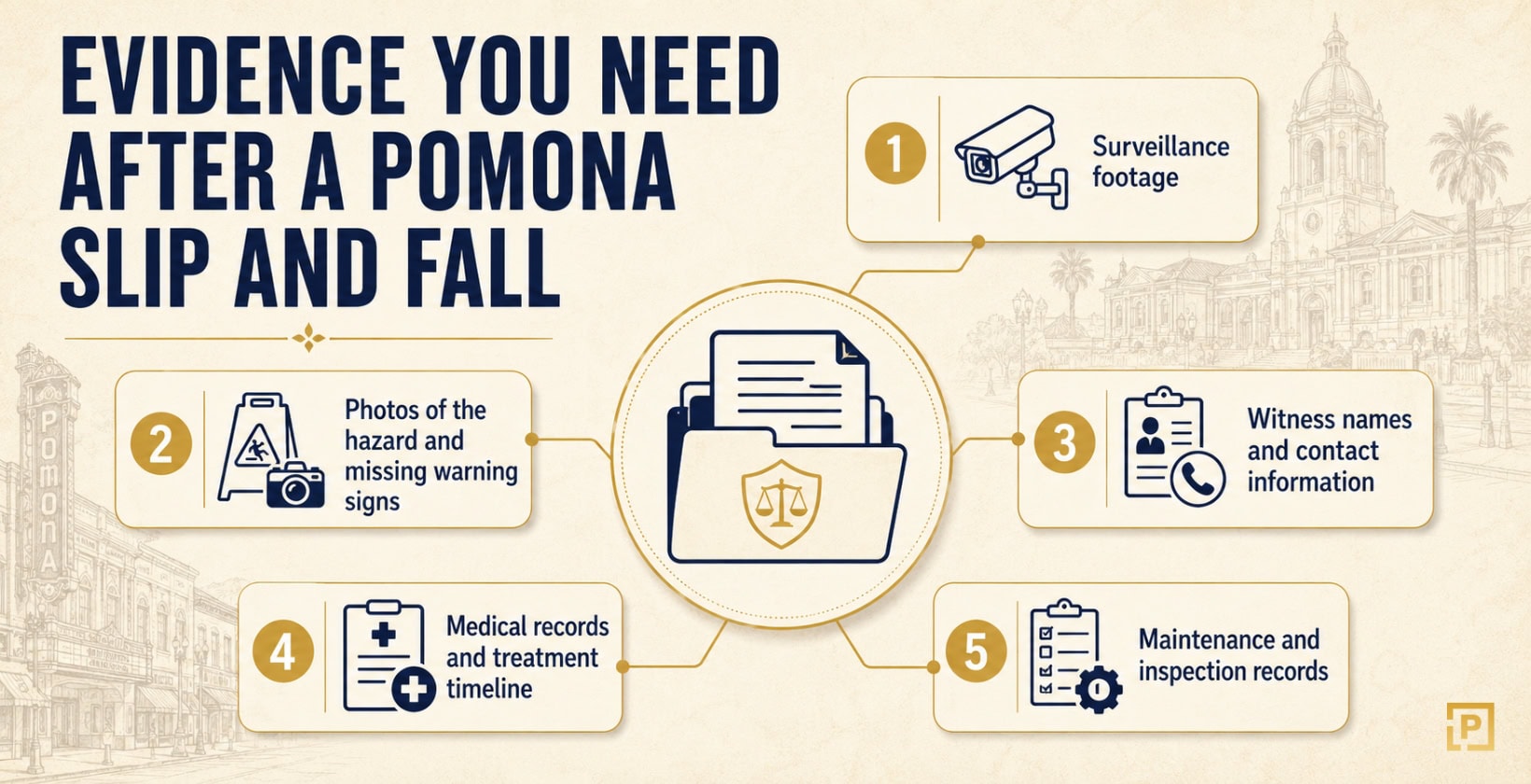
Slip and fall evidence must be gathered within the first 24 to 72 hours. Once the property is cleaned, repaired, or altered, the physical proof of the dangerous condition is gone.
- Surveillance footage. Most Pomona commercial properties have video systems that capture not just the fall itself but how long the hazard existed beforehand, which is often the key to proving constructive notice. This footage is routinely overwritten within 24 to 72 hours. An attorney must send a written evidence preservation demand letter immediately.
- Photographs. Photograph the hazard, the exact location, and any missing warning signs before the staff corrects the condition. Photograph your injuries at multiple stages of healing. Preserve everything in the original digital format with timestamps intact.
- Witness information. Collect names, phone numbers, and email addresses at the scene. Witness recollections shift within days, and contact details go stale. What you gather at the scene is almost always more reliable than what you can track down later.
- Medical records and treatment timeline. Every visit, diagnosis, referral, and prescription must be documented from the date of injury forward. Gaps in treatment are used by insurance adjusters as evidence that the injuries were not serious or were caused by something other than the fall.
- Maintenance and inspection records. Property owners keep internal inspection logs, cleaning schedules, and repair records. Obtained through discovery, these documents frequently show that the dangerous condition was known and never corrected, and sometimes reveal a pattern of prior incidents at the same location.
What Damages Can You Recover After a Pomona Slip and Fall?
California premises liability law allows injured fall victims to recover both economic and non-economic damages. The full scope of your recovery depends on the severity of your injuries, the duration of your treatment, the impact on your ability to work and live your daily life, and the strength of the evidence connecting the fall to the damages claimed.
Economic Damages
- Past and future medical expenses, including emergency care, surgery, physical therapy, imaging, prescriptions, and follow-up visits.
- Lost wages and income for time missed from work during recovery. If your injuries required you to reduce hours, switch roles, or stop working entirely during treatment, those losses are part of your claim.
- Loss of future earning capacity if the fall produced injuries that limit your ability to return to your prior occupation or perform the same level of work going forward.
- In-home care and daily assistance costs if your injuries required help with tasks you could previously perform independently, from transportation to personal care.
- Property damage if belongings were broken or destroyed in the fall.
Non-Economic Damages
- Pain and suffering, which accounts for the physical experience of the injury itself: the acute pain, the recovery process, and any chronic discomfort that persists after treatment ends.
- Emotional distress and psychological harm, including anxiety, sleep disruption, and the mental toll of managing an injury while handling medical appointments, reduced income, and uncertainty about recovery.
- Loss of enjoyment of life for activities, hobbies, and daily routines the injuries have prevented or limited.
- Loss of consortium for a spouse or domestic partner whose relationship has been affected by the injured person’s physical limitations or emotional harm.
Punitive Damages
In cases involving malice, oppression, or fraud, which are uncommon in standard premises liability claims, punitive damages may also be available. Your attorney will evaluate all categories of damages and build the evidence record to support each one.
In the most severe falls, those resulting in fatal injuries, surviving family members may have a separate wrongful death claim. Our Pomona wrongful death lawyer at Pérez Law, PC can evaluate whether a wrongful death claim applies alongside or in place of a personal injury claim.
Not sure what your case is worth? Pérez Law, PC, offers free case evaluations 24 hours a day. Call (909) 622-1071 or contact us online to get a realistic assessment of your claim.
Why Choose Pérez Law, PC for Your Pomona Slip and Fall Case?
Before Ricardo Antonio Pérez became a lawyer, he worked inside the industry you’re now up against, as a licensed private investigator and claims adjuster. He managed personal injury cases from both sides of the table before ever setting foot in a courtroom. He knows how carriers evaluate claims, what defense teams look for in the evidence record, and what it actually takes to move a case from denied liability to a fair resolution. That background doesn’t just appear in a biography. It shows up in how we build your case from day one.
The moment a fall happens on commercial property, the property owner’s insurer is already moving: they assign an adjuster, pull the incident report, and put a defense firm on standby if the case looks significant. Most injured people don’t speak to an attorney until days later. There is no upfront cost to retain Pérez Law, PC. The firm carries the cost of building your case while you recover.
Pérez Law, PC has represented injury victims across the Pomona Valley and Los Angeles County for more than two decades. Our Pomona office at 522 W Holt Ave is staffed with a bilingual personal injury team that has handled premises liability cases from initial investigation through settlement and, when necessary, through trial. The defense teams retained by Pomona-area property owners know this firm and know our client history.
Review our case results to understand the types of recoveries the firm has obtained for injury clients.
Frequently Asked Questions: Pomona Slip and Fall Claims
How Long Do I Have to File a Slip and Fall Claim in California?
The deadline depends on who owns the property. Private property claims must be filed within 2 years under CCP Section 335.1. Government property claims require a tort claim within 6 months under Government Code Section 911.2. The government deadline is covered in full above. If there is any chance your fall involved city-owned or government-maintained property, call us immediately. Missing that deadline almost always bars your case permanently.
What If I Was Partly at Fault for My Slip and Fall?
You can still recover compensation. California’s pure comparative negligence rule reduces your recovery by your percentage of fault, not eliminates it. The full explanation and a worked example are in the Comparative Negligence section above. The practical point: insurance adjusters routinely inflate your fault percentage to reduce the payout. An experienced attorney challenges those assignments with evidence of what the property owner knew and failed to do.
What Is My Slip and Fall Case Worth?
No attorney can give you an accurate number without knowing the facts of your specific case. What determines value: the severity and permanence of your injuries, total medical expenses, how long you missed work, whether you have ongoing limitations, and the strength of the evidence connecting the property owner’s negligence to your fall. A $50,000 claim and a $500,000 claim can both start with the same type of fall. The difference is usually in the injury severity and how well the evidence record was built. A free case evaluation with Pérez Law, PC, gives you a realistic assessment grounded in the specifics.
Do I Need to Go to Court for a Slip and Fall Case?
The majority of slip and fall claims resolve through pre-litigation negotiation or mediation without going to trial. However, not every property owner or insurer will offer a fair settlement voluntarily. When negotiation does not produce a reasonable result, filing a lawsuit and preparing for trial is often the only way to force a fair outcome. Pérez Law, PC is a trial-ready firm: our negotiation position is stronger because the other side knows we are prepared and willing to take cases to verdict.
What If the Store Manager Said They Are Not Responsible?
A store manager’s statement at the scene is not a legal determination of liability. Property owners and their employees routinely deny responsibility immediately after an incident. Your rights are governed by California premises liability law, not by what a manager says at the scene. Document the incident, collect evidence, seek medical attention, and contact an attorney. Do not sign any documents offered by the property owner or their insurer without legal counsel.
Can I Still File a Claim If I Did Not Report the Fall to the Property Owner?
California law does not require you to have filed an incident report with the property owner as a precondition of bringing a premises liability claim. Failing to report at the scene can complicate your case, particularly if the owner later claims they had no notice of the incident, but it does not automatically bar your claim. The key factors are the evidence of the dangerous condition, proof of the owner’s notice of that condition, and documentation of your injuries and treatment.
Ready to Talk to a Pomona Slip and Fall Attorney?
Trusted Injury Lawyers. Decades of Experience. Millions Recovered.
Pérez Law, PC offers free, no-obligation case evaluations 24 hours a day, 7 days a week. You pay no attorney fee unless we recover on your behalf. Our Pomona office is located at 522 W Holt Ave, Pomona, CA 91768, and our team is bilingual in English and Spanish.
Call us at (909) 622-1071 or toll-free at (877) 622-5888, or start a free case evaluation online to speak with a member of our team today.
Past results do not guarantee future outcomes. Every case is different.