
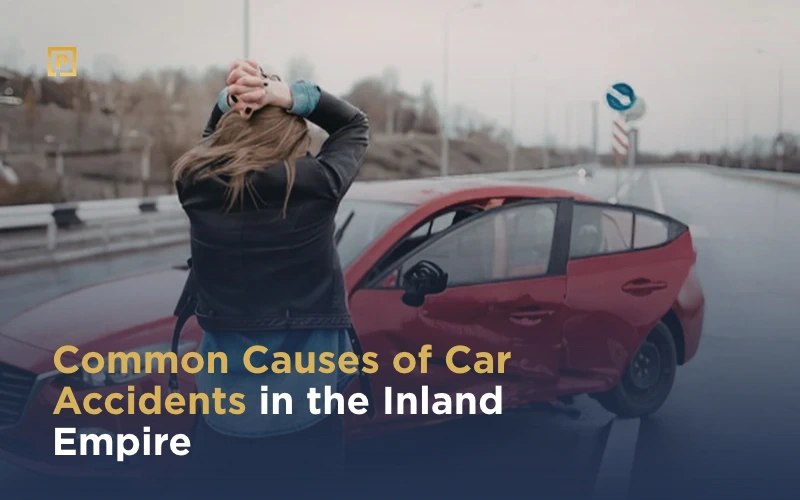
A crash on the I-10 in Ontario or the I-15 near Fontana leaves you hurting and asking one question: why? The other driver’s insurer has its own answer, and waiting lets crash evidence fade.
Most car accidents in the Inland Empire, the San Bernardino and Riverside County region east of Los Angeles, start with driver error, including speeding, distracted driving, impaired driving, tailgating, red-light running, unsafe turns and lane changes, and drowsy driving. High freeway speeds, warehouse truck traffic, and long commutes make these mistakes more dangerous on the I-10, I-15, and SR-60.
6,201 speed-related fatal and injury collisions in 2023
According to the California Office of Traffic Safety (OTS), San Bernardino and Riverside Counties logged 6,201 speed-related fatal and injury collisions in 2023.
If you were hurt, the cause also points to who is responsible. Our Ontario car accident lawyers at Pérez Law, PC use it to show who should pay your medical bills.
Key Takeaways
- Driver error is the leading crash factor: a federal study of 2005 to 2007 crashes traced the critical reason for about 94% to a driver.
- High speeds, truck traffic, and long commutes raise crash risk on Inland Empire freeways such as the I-10, I-15, and SR-60.
- Potholes, dead traffic signals, and worn tires can cause crashes even when every driver follows the rules.
- In California, breaking a traffic safety law that causes a crash can create a rebuttable presumption of negligence under Evidence Code §669.
7 Common Causes of Car Accidents in the Inland Empire
Driver errors cause many Inland Empire crashes, and each one breaks a specific California traffic law or the general duty to drive with care. Speeding comes first because NHTSA research shows that higher speed increases crash severity.
| # | Cause | How It Happens on Inland Empire Roads | California Law or Duty It Breaks |
|---|---|---|---|
| 1 | Speeding or driving too fast for conditions | 70 mph into stop-and-go traffic on SR-60, or full speed on a wet freeway | Vehicle Code §22349 (65 mph maximum on most highways) and §22350 (Basic Speed Law) |
| 2 | Distracted driving | Holding a phone to text or scroll a map, eating, or adjusting a dashboard screen | Vehicle Code §23123.5 for handheld phones; the general duty of care (Civil Code §1714) for other distractions |
| 3 | Impaired driving | Alcohol, cannabis, or prescription drugs that slow judgment and braking | Vehicle Code §23152 |
| 4 | Tailgating | Following too close behind trucks and commuters, which can cause chain-reaction rear-end crashes | Vehicle Code §21703 |
| 5 | Red-light running and failure to yield | Running a red light or a stop sign at a busy intersection, which can cause a T-bone crash | Vehicle Code §21453 and §21802 |
| 6 | Improper turns and lane changes | Turning or changing lanes at interchanges without checking blind spots, which can cause sideswipes | Vehicle Code §22107 |
| 7 | Drowsy driving | Late shifts and long commutes to Los Angeles and Orange County, which can lead to drifting across lane lines or running off the road | General duty of care, Civil Code §1714 |
Driver error runs through every row on this list. In California, a broken safety rule is a common starting point for showing which driver was at fault.
Is Driver Error the Leading Factor in California Car Accidents?
Yes. In a National Highway Traffic Safety Administration (NHTSA) study of crashes from 2005 to 2007, the driver was the critical reason, often the last failure before impact, in about 94% of cases. NHTSA notes that a critical reason isn’t an assignment of fault. In 2023, OTS data for San Bernardino and Riverside Counties tied more than 6,000 fatal and injury collisions to speeding alone.
Why Is Speeding Such a Common Crash Cause on Inland Empire Roads?
Speeding is such a common cause of crashes on Inland Empire roads because long, open freeways invite high speeds, and traffic stops without warning. The California Office of Traffic Safety’s 2023 San Bernardino County crash rankings show 3,107 speed-related fatal and injury collisions. The 2023 Riverside County crash rankings show 3,094 more for the same year.
Speeding covers more than the number on the sign. California’s Basic Speed Law bars driving faster than is safe for traffic, weather, or visibility. Under that law, 60 mph in heavy rain on the 215 can be a violation, even in a 65 mph zone.
What Makes Inland Empire Roads Dangerous for Drivers?
Inland Empire roads are dangerous for drivers because high speeds, truck traffic, and busy roads meet on the same freeways. Commuters heading to Los Angeles and Orange County share the I-10, I-15, SR-60, and SR-91 with tractor-trailers serving warehouses in Ontario and Moreno Valley.
A fully loaded truck at highway speed can need nearly two football fields to stop, according to the Federal Motor Carrier Safety Administration (FMCSA), so a truck that follows too closely can start a multi-vehicle crash. Truck crash claims can involve federal trucking rules and more than one insurance policy. Our Ontario truck accident lawyers handle both.
| Hazard | Where It Shows Up | Common Crash Type |
|---|---|---|
| Freeway speed and congestion | I-10, I-15, I-215, SR-60, SR-91, SR-210 | Rear-end and chain-reaction crashes |
| Warehouse truck traffic | Ontario, Moreno Valley, and other warehouse hubs | Jackknife, underride, and sideswipe crashes |
| Long commutes | Inland Empire routes to Los Angeles and Orange County | Drowsy drivers running off the road |
| High winds | I-15 and SR-60 in Riverside County during Santa Ana winds | Big-rig rollovers and lane drift by tall vehicles |
| First rain after dry months | Every freeway and arterial | Skids on oil-slick pavement |
Why Are High Desert Roads Risky for Drivers?
High Desert roads are risky for drivers because rural roads and distracted drivers combine at highway speed. SR-62 and SR-138 cross open High Desert country, with stretches that have no median. In 2018, Caltrans, the state transportation department, proposed centerline rumble strips on parts of SR-62 to reduce cross-centerline crashes.
A driver who looks at a phone for two seconds can drift across the center line. On an undivided highway, the next thing in that lane is oncoming traffic. On roads like these, a crumbling shoulder or a bald tire can start a crash before any driver makes a mistake.
Can Road Conditions or Vehicle Defects Cause Car Accidents in the Inland Empire?
Yes, road conditions and vehicle defects cause car accidents in the Inland Empire, even when every driver follows the rules. Poor road conditions and mechanical failures take control away from the driver. Common examples include:
- Potholes and broken pavement: A wheel drops and pulls the car hard into the next lane.
- Dead or malfunctioning traffic signals: Two drivers both believe they have the right of way.
- Construction zones without proper signs: Lanes shift with no warning at freeway speed.
- Worn tires: Tire blowouts or skidding due to overly worn tread, a risk that rises on slick pavement after the first rain.
- Brake and steering failures: A car that can’t stop or turn puts everyone around it at risk.
A defect shifts the question from what a driver did to who built, repaired, or maintained the part that failed. Proving a defect can take repair records, recall notices, or road maintenance logs, and a California car accident lawyer handles claims built on that evidence.
How Does the Cause of a Crash Affect Fault in California?
The cause of a crash points to who is at fault in California. Under Evidence Code §669, a driver who breaks a safety law and causes a crash is generally presumed negligent. For example, a driver who runs a red light and causes a crash is presumed careless. That driver then has to prove they acted as a reasonably careful driver would.
Some causes make someone other than the driver responsible:
- A driver on the job: The employer can share responsibility for a crash caused by a truck, delivery van, or company car driver.
- A dangerous road or broken signal: The city, the county, or Caltrans can be responsible under Government Code §835. A written claim is due within six months.
- A defective part or bad repair: The manufacturer or the repair shop can be responsible.
Fault doesn’t have to be all or nothing. California follows pure comparative negligence law, set by Li v. Yellow Cab Co. (1975), so you can still recover money even if you were partly to blame. Your award is reduced by your share of the fault.
The responsible party matters for one more reason. California’s minimum liability coverage is only $30,000 per person, $60,000 per accident, and $15,000 for property damage under Vehicle Code §16056. A serious injury can cost more than those limits. Medical bills, lost wages, and pain and suffering all count among the types of compensation after a car accident in California.
Each additional responsible party can bring another insurance policy into the claim. Our guide on how car accident settlements work in California explains what happens when policy limits run out.
How Is the Cause of an Inland Empire Car Accident Proven?
The cause of an Inland Empire car accident is proven with physical, digital, and witness evidence, such as police collision reports, event data recorder downloads, video footage, and phone records. Each source answers a different question about what happened, and much of it can be lost quickly if no one preserves it.
| Evidence | What It Can Show |
|---|---|
| Traffic collision report (CHP or local police) | The officer’s view of the main cause (the primary collision factor) and any citations issued |
| Event data recorder (“black box”) | Speed, braking, and throttle in the seconds before impact |
| Dashcam, doorbell, and business video | How every vehicle actually moved |
| Phone records | Texting or calling at the moment of the crash |
| Toxicology and arrest records | Alcohol or drug impairment |
| Electronic logging device (ELD) data, a federal hours-of-service record for commercial trucks | A truck driver’s hours behind the wheel |
| Scene photos and witness statements | Skid marks, debris, signal timing, and weather |
Evidence fades fast. Many business security systems record over old footage automatically, and skid marks wash away with the next rain. Our guide on what to do after a car accident in California explains how to protect your claim.
Frequently Asked Questions About Inland Empire Car Accident Causes
What If the Driver Who Caused My Crash Was Uninsured or Fled the Scene?
Your own uninsured motorist (UM) coverage, part of your auto policy, can pay for your injuries when the at-fault driver was uninsured or fled. Insurers must include it unless you deleted it in writing. Hit-and-run claims need physical contact and a police report within 24 hours, then a sworn statement to your insurer within 30 days.
What If a Rideshare or Delivery Driver Caused My Car Accident?
A rideshare driver who caused your car accident can bring $1 million in liability coverage into the claim. Public Utilities Code §5433 sets that limit once a driver accepts a ride, with lower limits while the app is on. Delivery apps follow separate insurance rules.
How Long Do I Have to Report a Car Accident in California?
You have 24 hours to report a car accident in California to the CHP or local police if anyone was hurt or killed. You have 10 days to file an SR-1 report with the DMV when anyone was hurt or damage is over $1,000. Skipping it leads to a license suspension.
How Much Does It Cost to Talk to a Lawyer About My Car Accident?
It costs nothing to talk to our lawyers about your car accident. We handle cases on a contingency fee basis, so you pay nothing unless we win or settle your case. Our guide on when to hire a car accident lawyer in the Inland Empire explains why calling early helps.
Talk to an Inland Empire Car Accident Lawyer About Your Crash
You don’t need every answer about your crash before you call. Tell us what happened on the road, and we’ll tell you what we think caused it, who could be responsible, and what comes next. The call is free.
At Pérez Law, PC, our founder, Ricardo Antonio Pérez, worked as a licensed private investigator and insurance claims adjuster before he became a lawyer in 1998. Our field investigator, Erick Pérez, conducts accident scene investigations and witness interviews.
Pérez Law Stands by You and Your Loved Ones.
Call our Ontario office at (909) 983-2235, our Pomona office at (909) 622-1071, or (877) 622-5888 24/7. You can contact Pérez Law online any time. We help families in Ontario, Rancho Cucamonga, Fontana, San Bernardino, Chino, Upland, and Pomona. Hablamos español.
Attorney Advertising. This article provides general information about California car accidents and is not legal advice. Reading it does not create an attorney-client relationship.