
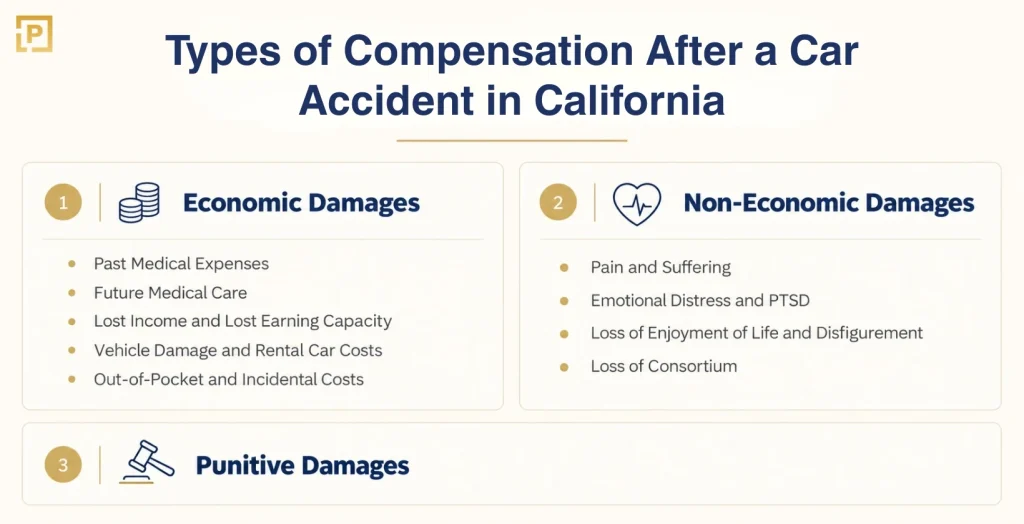
California law organizes the types of compensation after a car accident into three categories: economic damages, non-economic damages, and punitive damages when a driver acted with malice, oppression, or fraud under California Civil Code Section 3294.
Most people dealing with medical bills and missed work know they can claim those costs. What insurers won’t tell you is that your claim can extend to future surgeries you haven’t had yet, the income a permanent injury prevents you from earning over your working life, and every out-of-pocket expense tied to your recovery. California does not cap non-economic damages in car accident cases, although Proposition 213 bars some uninsured drivers from recovering them. MICRA caps pain and suffering only in medical malpractice cases, not car accidents.
At Pérez Law, PC, we have represented injured victims from Ontario, Pomona, and across the Inland Empire since 1998. This guide covers the main categories of compensation California law allows and the tactics insurers use to undervalue or omit them.
Call our toll-free number (877) 622-5888 for a free, confidential case evaluation. We work on a contingency fee basis, so you pay nothing unless we recover compensation for you.
Past results do not guarantee future outcomes. Every case is different.
Key Takeaways
- Economic Damages cover every documented financial loss: past and future medical expenses, lost wages, lost earning capacity, vehicle repair, rental costs, and out-of-pocket costs. Insurers fight the amount, not the existence of these losses.
- Non-Economic Damages have no statutory cap in California car accident cases. Recoverable categories include pain and suffering, emotional distress, PTSD, loss of enjoyment of life, disfigurement, permanent scarring, and loss of consortium (a separate claim that belongs to your spouse or registered domestic partner).
- Punitive Damages are punishment awarded on top of all compensatory damages when a driver acted with malice, oppression, or fraud. DUI crashes and street racing are among the situations where punitive damages may be pursued.
- Proposition 213 bars uninsured drivers from recovering non-economic damages even when the other driver was entirely at fault. That bar can lift for an uninsured vehicle owner if the at-fault driver is convicted of DUI. Economic damages remain recoverable regardless.
- In most California car accident injury cases, you have two years from the date of injury to file a lawsuit. If a government agency may be responsible, you must present a written claim to that agency within six months. Missing a deadline can bar your case, so talk to a lawyer early.
Economic Damages: The Financial Losses You Can Document
Economic damages are the foundation of every California car accident claim. They cover losses with a paper trail: medical bills, pay stubs, repair invoices, and expert projections. Insurers accept that these losses exist. What they fight is the amount.
Knowing exactly what belongs in this category and how California law calculates each item prevents you from accepting less than what the evidence supports.
Past Medical Expenses
Every reasonable and necessary medical bill from the date of your crash forward is recoverable. Emergency room treatment, ambulance transport, hospitalization, surgery, specialist consultations, diagnostic imaging, physical therapy, chiropractic care, prescription medications, and durable medical equipment all belong here. One California rule changes how this number is calculated, and insurers count on you not knowing it.
That rule comes from Howell v. Hamilton Meats & Provisions, Inc. (2011) 52 Cal. 4th 541. If your provider accepted a reduced amount as payment in full, such as a payment from your health insurer, your recovery for that bill is limited to the amount actually paid, not the amount billed. For example, if a hospital billed $50,000 and your insurer paid $14,000 as payment in full, your recovery on that item is $14,000, not $50,000. Different rules can apply if you had no health insurance or received treatment on a lien. California courts have since held that full billed amounts also cannot be used to value future care. Future medical damages are based on the reasonable cost of care you are reasonably certain to need, supported by expert testimony.
Future Medical Care
Future medical care is where a serious injury case separates from a minor one. You may recover the reasonable cost of treatment you are reasonably certain to need over your remaining life expectancy. That includes follow-up surgeries, long-term physical therapy, future specialist visits, home modifications for permanent disabilities, and in-home care for catastrophic spinal cord or brain injuries.
Serious future-care claims are often supported by a certified life care planner who works with your treating physicians to project those costs. A forensic economist can then convert that projection into a present-value lump sum. Insurers often hire their own experts to challenge these projections. We help you build an expert record designed to withstand those challenges.
Lost Income and Lost Earning Capacity
Lost income and lost earning capacity are two separate claims, and the second is often larger in serious injury cases. Lost income covers wages, salary, bonuses, and benefits missed while recovering. If you used paid sick leave or vacation time, that time is still a compensable loss.
Lost earning capacity is the permanent gap between what you would have earned over your working life and what you can now earn because of your injuries. A warehouse worker who cannot return to physical labor after a lumbar spine injury carries a different claim than a software engineer who loses fine motor function after a hand fracture. Both claims are often supported by a vocational expert and a forensic economist who project the lifetime earnings gap. Without expert testimony to support it, insurers often discount this category heavily.
Vehicle Damage and Rental Car Costs
You may recover the reasonable cost of repairs that restore your vehicle to its pre-accident condition, or its fair market value if it is a total loss. Insurers often rely on valuation reports that may understate what your vehicle actually sells for in your local market. An independent appraisal and comparable private-sale listings in the Ontario and Pomona area can support a more accurate figure.
If your vehicle was undrivable after the accident, you may recover rental costs or loss of use for a reasonable repair or replacement period. Personal property destroyed in the crash, including child safety seats, laptops, and prescription eyeglasses, is compensable. Keep receipts and document every item.
Out-of-Pocket and Incidental Costs
Every reasonable expense caused by your accident belongs in your claim, and insurers rarely raise these costs on their own. Keep a log of mileage to every medical appointment, along with receipts for parking at hospitals and pharmacies, over-the-counter medications, home care hired during recovery, and childcare costs your injuries made necessary. Individually, these amounts are small. Together, they are documented losses that belong in your demand.
At Pérez Law, PC, we help you document your economic losses, including the items insurers often leave out.
Call our toll-free number (877) 622-5888 for a free consultation.
Non-Economic Damages: The Losses Insurers Work Hardest to Minimize
Non-economic damages compensate for harm that has no receipt and no pay stub. California Civil Jury Instruction CACI 3905A defines the compensable categories: physical pain, mental suffering, loss of enjoyment of life, disfigurement, physical impairment, inconvenience, grief, anxiety, humiliation, and emotional distress. No fixed standard exists for calculating the amount. The jury uses judgment and common sense, guided by the evidence you present. For a seriously injured person with strong documentation, there is no statutory ceiling on what a jury can award.
Pain and Suffering
Some insurers estimate pain and suffering by applying a multiplier to economic damages or by running the claim through valuation software. A first offer often falls well below what the evidence supports. What treating physician records, functional capacity evaluations, and consistent documented complaints support is a different number. No California statute sets a formula for this category. The evidence sets the number.
Emotional Distress and PTSD
Emotional distress is compensable under CACI 3905A and can include anxiety, depression, PTSD, nightmares, and chronic sleep disruption connected to the crash. Without documentation, adjusters often assign it little value. A diagnosis from a licensed mental health provider, treatment records, and testimony about daily impact make this category much harder for an insurer to dismiss.
Loss of Enjoyment of Life and Disfigurement
Some injuries take away what defined your life before the crash, such as coaching your child’s team, running, or getting through a workday without pain. If that has happened to you, you may have a claim for loss of enjoyment of life under CACI 3905A. Disfigurement and permanent scarring carry independent weight and can be compensated separately from the pain that caused them.
Loss of Consortium
Loss of consortium is a separate claim filed by the spouse or registered domestic partner of the injured person under CACI 3920. It compensates for the loss of love, companionship, comfort, care, assistance, protection, affection, society, moral support, and the enjoyment of sexual relations. California Family Code Section 297.5 extends this right to registered domestic partners. Insurers rarely raise it on their own.
If your spouse was seriously injured in a car accident in Ontario, Pomona, or anywhere in the Inland Empire, call us now. We can review which non-economic losses, including loss of consortium, may apply to your family.
Punitive Damages: When California Law Allows More
Punitive damages are not compensatory. They are punishments, awarded on top of economic and non-economic damages when the defendant’s conduct meets an elevated legal standard. Under California Civil Code Section 3294, punitive damages can be awarded only if the plaintiff proves by clear and convincing evidence that the defendant acted with malice, oppression, or fraud. That threshold is far above ordinary negligence.
In car accident cases, punitive damages may be available when the at-fault driver’s conduct meets the Section 3294 definition of malice, meaning despicable conduct carried on with a willful and conscious disregard for the safety of others. Impaired driving combined with aggravating facts, or street racing, can support that claim. A DUI arrest alone does not guarantee punitive damages. When punitive damages are awarded, they are added on top of all compensatory damages. No statute caps the amount, although courts review awards to make sure they are not excessive.
What If You Were Partly at Fault?
California follows pure comparative fault, meaning your compensation is reduced by your percentage of fault, not eliminated. Established by the California Supreme Court in Li v. Yellow Cab Co. (1975) 13 Cal. 3d 804, this rule allows recovery even if you were 99% responsible for the accident. If you were 30% at fault in a $100,000 case, you recover $70,000. Adjusters mine for any evidence you contributed: a delayed brake application, a lane change, a missed right-of-way yield. All of it becomes leverage against your settlement offer.
At Pérez Law, PC, our lawyers work to document the other driver’s fault early, building a factual record that can counter comparative fault arguments before they reduce your settlement offer.
What If the At-Fault Driver Had No Insurance or Insufficient Coverage?
If the driver who hit you had no insurance or not enough coverage to compensate you fully, California law gives you additional recovery options.
- Uninsured Motorist Coverage: California Insurance Code Section 11580.2 requires every California auto policy to include UM coverage unless you explicitly waive it in writing. If the at-fault driver was uninsured, you make a claim against your own UM policy for the same damages you would have claimed against the at-fault driver, up to your UM policy limits.
- Underinsured Motorist Coverage: f the at-fault driver’s liability limits are lower than your own UIM limits, your UIM coverage may pay the difference. For example, with $100,000 in UIM coverage and a $30,000 payment from the at-fault driver’s insurer, your UIM coverage could pay up to $70,000. Check your own policy for UIM coverage, because it matters most when the at-fault driver’s policy cannot cover a serious injury.
- Additional Defendants: We investigate whether any other party shares liability. That can include the vehicle owner, the at-fault driver’s employer if the driver was working at the time, or a government entity if a road defect contributed. Each one may be a separate source of coverage that adds to your total recovery.
Driving Without Insurance: How Proposition 213 Limits Your Recovery
If you were driving without valid car insurance at the time of an accident, California’s Proposition 213, codified at Civil Code Section 3333.4, can sharply limit your recovery even when the other driver was entirely at fault. An uninsured driver cannot recover non-economic damages. No pain and suffering. No emotional distress. Economic damages, including medical bills, lost wages, and vehicle repairs, remain available.
This restriction can apply even when you did nothing wrong, such as being stopped at a red light and rear-ended by a driver who was texting. California voters approved Proposition 213 in 1996 to give drivers a financial reason to carry the insurance the law requires. Under Vehicle Code Section 16056, as amended by SB 1107 effective 2025, the minimum coverage is $30,000 per person and $60,000 per occurrence for bodily injury, plus $15,000 for property damage. The penalty, forfeiture of all non-economic damages, is not subject to judicial discretion.
The statute itself contains one exception. Under Civil Code Section 3333.4 subdivision (c), an uninsured vehicle owner injured by a driver convicted of DUI under Vehicle Code Section 23152 or 23153 is not barred from recovering non-economic damages. Courts have also limited Prop 213 in other situations. For example, it does not apply to a product defect claim against a vehicle manufacturer.
Contact us at our toll-free number (877) 622-5888 before assuming you have no non-economic claim.
What the Insurance Adjuster Won’t Tell You About Your Compensation
When the at-fault driver’s insurer assigns an adjuster to your claim, their job is not to determine what you are fairly owed. It is to close your file for as little as possible. Every category of compensation described here is established under California law.
Here is what adjusters systematically undervalue or exclude:
| Compensation Category | What Adjusters Offer | What California Law Entitles You To |
|---|---|---|
| Future medical expenses | Nothing, or a token amount | Full projected lifetime cost based on your treating physicians’ recommendations and a life-care plan |
| Lost earning capacity | Only documented missed days of work | Full projected career earnings reduction over your working lifetime, calculated by a forensic economist |
| Pain and suffering | 1x to 1.5x medical bills for any injury | No statutory cap. Amount is determined by evidence and jury judgment under CACI 3905A |
| Loss of consortium | Rarely raised voluntarily | A separate claim for your spouse’s loss of companionship, intimacy, and support under CACI 3920 |
| Out-of-pocket expenses | Nothing unless itemized and demanded | All reasonable expenses causally connected to the accident, including mileage and home care |
| Punitive damages | Nothing; treated as irrelevant | Available under Civil Code Section 3294 when the defendant acted with malice, oppression, or fraud |
Before founding Pérez Law, PC, Ricardo Antonio Pérez worked as a private investigator and as an insurance claims adjuster. He knows how adjusters build their files, what they minimize, and how they decide what to offer. That is the foundation we bring to every car accident claim we negotiate. We serve clients in Pomona, Ontario, and across the Inland Empire.
Frequently Asked Questions
Who Pays My Medical Bills Immediately After a Car Accident?
Right after a car accident, your medical bills are paid through your own coverage while your claim is pending. If your auto policy includes Medical Payments (MedPay) coverage, it can pay accident-related medical bills regardless of fault, up to your policy limit. Your health insurance may also pay, and it may seek reimbursement from your settlement. If you have no health insurance, some providers will treat you on a lien and wait for payment until your case resolves. The at-fault driver’s insurer does not pay bills as they come in. It pays once, at settlement or judgment.
What Happens If the Insurance Company Makes a Low First Offer?
If the insurance company makes a low first offer, do not accept it before your medical treatment is complete. Future care costs, lost earning capacity, and non-economic damages cannot be accurately valued until your injuries have fully developed. Once you sign a release, your claim is closed permanently.
How Long Do I Have to File a Car Accident Claim in California?
Most personal injury lawsuits from a California car accident must be filed within two years of the injury under Code of Civil Procedure Section 335.1. Property damage claims have three years under Section 338. Claims against a city, county, or state agency require a written government claim within six months under Government Code Section 911.2. If you miss that window, you may be able to apply to present a late claim within one year of the accident. Exceptions can shorten or extend these deadlines, so confirm your dates with a lawyer as soon as possible.
How Much Is a Car Accident Settlement Worth in California?
A California car accident settlement depends on your injuries, medical costs including future care, lost income and earning capacity, and the strength of liability evidence. The at-fault driver’s policy limits often cap what their insurer will pay. California’s minimum is just $30,000 per person, so your own UIM coverage or other responsible parties can matter as much as the injury itself.
What Is the Difference Between Compensatory and Punitive Damages?
Compensatory damages cover both economic and non-economic losses and restore you to the position you would have occupied had the accident not occurred. Punitive damages are a punishment awarded on top of compensatory damages when the defendant acted with malice, oppression, or fraud under California Civil Code Section 3294. They are not available for ordinary negligence.
Speak with a California Car Accident Lawyer Today
Medical bills and missed work are the visible part of what you lost. California law may allow you to recover far more, and the difference between what an adjuster offers and what your claim is actually worth is the gap we work to close.
Pérez Law, PC has represented injured people from Pomona, Ontario, Rancho Cucamonga, and communities across the Inland Empire since 1998. We work on a contingency fee basis, so you pay no attorney fees and no case costs unless we recover compensation for you.
See our case results, including a $1.5 million recovery for a client injured in a T-bone collision that caused a rollover crash.
Call our toll-free number (877) 622-5888 or schedule your free consultation online. We serve clients in English and in Spanish.
Hablamos español.
Our Ontario office is located at 822 N Euclid Ave, Ontario, CA 91762, and can be reached at (909) 983-2235. Our Pomona office is at 522 W Holt Ave, Pomona, CA 91768, and can be reached at (909) 622-1071.
Past results do not guarantee future outcomes. Every case is different.