
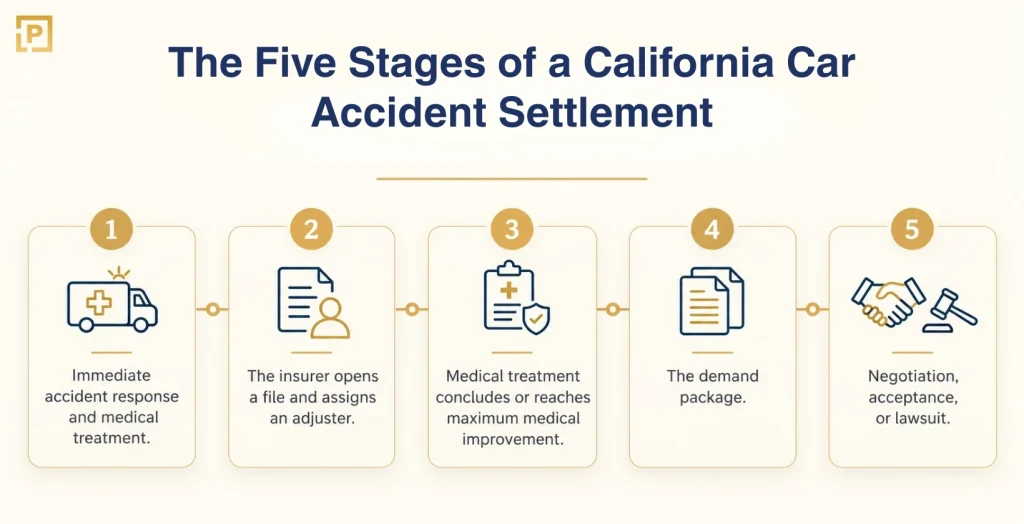
After a California crash, bills and missed paychecks pile up fast, and your settlement decides how much you recover. California is an at-fault state, so the driver who caused your crash is responsible for your injuries through their liability insurance. Most California car accident injury claims move through five stages, and many injured people have up to three pathways to pursue compensation.
Before becoming a California personal injury attorney, Ricardo Antonio Pérez worked as a private investigator and an insurance claims adjuster. He saw firsthand how insurance companies evaluate claims. As the founder of Pérez Law, PC, he now uses that knowledge to help injured clients throughout the Inland Empire. Knowing how the settlement process works before you speak to an adjuster puts you in a stronger position.
Call (877) 622-5888 for a free case evaluation. Se habla español.
Recent Result: $1,500,000 Recovery for T-Bone Rollover CollisionIn one published result, a client suffered serious injuries when a T-bone collision caused their vehicle to roll over. The case required complete liability documentation, a full damages record including future medical projections, and careful management through the demand and negotiation stages. The result was a $1,500,000 T-bone rollover recovery. View all case results. |
Three Ways to Pursue a California Car Accident Claim
In California’s fault-based system, you file against the at-fault driver’s insurer, not your own, for the core of your compensation. No-fault states work differently. There, every driver turns to their own insurer first, regardless of fault.
Up to three pathways may be available for resolving a California car accident claim, and they often run at the same time:
- Pathway 1: First-party claim against your own insurer
If your policy includes Medical Payments (MedPay) or collision coverage, those benefits pay regardless of who caused the crash. MedPay reimburses medical bills without waiting for the liability claim to resolve. Uninsured/underinsured motorist (UM/UIM) coverage also pays from your own policy, but only when the other driver was at fault and lacks enough insurance to cover your losses. Check your own policy declarations page before assuming MedPay is unavailable to you. - Pathway 2: Third-party liability claim against the at-fault driver’s insurer
You submit a claim to the other driver’s insurance company for your injuries and losses. - Pathway 3: Personal injury lawsuit
When negotiation fails, filing a lawsuit moves the claim into the formal legal process.
If your crash happened while you were performing job duties, you may have both a workers’ compensation claim and a third-party injury claim. A workers’ compensation carrier that pays benefits can assert a lien against your third-party recovery and may claim a credit against future benefits. Handling both claims together affects how much of the settlement you keep.
The Five Stages of a California Car Accident Settlement
Stage 1: Immediate accident response and medical treatment.
Get medical care right away. Your health comes first. A gap between the crash and your first doctor visit also gives the adjuster grounds to argue the crash didn’t cause your injury. The medical records from the first days after the accident become the foundation of your damages claim.
Stage 2: The insurer opens a file and assigns an adjuster.
The at-fault driver’s insurer opens a claim file promptly upon notification. Under California’s Fair Claims Settlement Practices Regulations, the insurer must acknowledge your claim and begin any needed investigation within 15 calendar days of notice. The adjuster sets a reserve, an internal estimate of what the claim will cost, and evaluates the claim against it.
Adjusters value a claim by weighing a few core factors. These include how clear fault is, the treatment you received and any gaps in it, your total medical bills, and the at-fault driver’s policy limits. They also consider the county where the case would be filed, since juries in some counties tend to award more than others. Some insurers run medical records through claims-evaluation software that assigns values from diagnosis and treatment codes. That means how your doctors document an injury can change what it’s worth. Ricardo Antonio Pérez saw these factors at work as an insurance claims adjuster, and they shape what a strong demand package needs to show.
Stage 3: Medical treatment concludes or reaches maximum medical improvement.
Attorneys often recommend waiting until you reach maximum medical improvement (MMI) before sending a settlement demand. MMI is the point where your treating physician confirms your condition has stabilized. Settling before MMI means you can’t know the full scope of your injuries or future medical costs.
Stage 4: The demand package.
Your attorney sends a formal demand letter to the at-fault driver’s insurer. It includes an account of who was at fault, your medical records and bills, proof of lost wages, expert opinions where needed, and a settlement figure. The demand starts above the amount you expect to accept, because negotiation moves down from the opening number.
Stage 5: Negotiation, acceptance, or lawsuit.
The insurer responds with a counteroffer. Multiple rounds of negotiation follow. If the parties close the gap, the case resolves. If they cannot reach an agreement, filing a lawsuit applies formal pressure and begins discovery.
What a California Car Accident Settlement Can Cover
A California car accident settlement can include both economic and non-economic damages. California has no general dollar cap on either type in car accident cases, with one major exception. Under Proposition 213 (Civil Code § 3333.4), some people generally cannot recover non-economic damages such as pain and suffering. This applies to uninsured drivers, owners of uninsured vehicles, and drivers convicted of DUI in connection with the crash. The MICRA cap on pain and suffering applies to medical malpractice cases, not car accidents.
- Economic damages: Past and future medical bills, wages lost while you recover, and property damage. They also cover lost earning capacity if the injury permanently limits your ability to work, plus out-of-pocket costs caused by the crash
- Non-economic damages: Pain and suffering, emotional distress, and loss of enjoyment of life when the injury keeps you from activities you enjoyed before the crash. Your spouse or registered domestic partner may also have a separate loss of consortium claim.
- Punitive damages ([Cal. Civ. Code §3294]): Available when clear and convincing evidence shows the at-fault party acted with malice, oppression, or fraud. Crashes caused by drunk driving may support a punitive damages claim, depending on the facts. Punitive damages are not covered by the insurer’s liability policy and require pursuing the driver personally.
Call (877) 622-5888 for a free case evaluation. No obligation. Se habla español.
How California’s Pure Comparative Fault Rule Changes Your Recovery
California follows the pure comparative fault rule established in Li v. Yellow Cab Co. (1975) 13 Cal.3d 804 and grounded in Civil Code § 1714. You can recover compensation even if you were partially responsible for the crash. Your recovery is reduced by your percentage of fault, but being partly at fault does not bar you from recovering. If your damages total $100,000 and you are found 25 percent at fault, you recover $75,000.
Adjusters assign initial fault percentages in their internal claims evaluation. Those numbers are the insurer’s negotiating position, not a court determination. Evidence such as photos, witness statements, and the crash report can challenge those percentages before negotiations reach a final number.
California Minimum Insurance Requirements and What Happens When Policy Limits Are Not Enough
California’s minimum auto insurance requirements changed on January 1, 2025, under SB 1107, also known as the Protect California Drivers Act. The current minimums are $30,000 per person, $60,000 per accident, and $15,000 for property damage (30/60/15). The previous 15/30/5 minimums are no longer the legal standard.
Even at the new minimums, policy limits are often too low to cover serious injuries. For many injured people, the at-fault driver’s policy limit is the practical ceiling on recovery. Say your damages are $200,000 and the driver carries only the $30,000 minimum. The most you can usually recover from that policy is $30,000. Underinsured motorist (UIM) coverage on your own policy may add more. In California, UIM benefits are reduced by what the at-fault driver’s insurer pays. So a $100,000 UIM policy plus a $30,000 liability payment can provide up to $70,000 more. A car accident lawyer can handle the third-party claim and your UIM claim at the same time.
Settlement vs. Lawsuit: When Negotiation Ends and When Mediation Resolves It
California car accident cases can resolve through negotiation before a lawsuit, during litigation (often at mediation or a settlement conference), or at trial. Where your case ends up depends on liability disputes, injury severity, and how far apart the parties are on value.
Filing a lawsuit does not mean going to trial. It means entering the discovery phase, where both sides exchange documents, take depositions, and respond to formal interrogatories. Discovery frequently produces additional evidence that shifts each side’s assessment of the case. The credibility of a lawsuit threat depends on whether the insurer believes the attorney will actually try the case.
Mediation is a non-binding settlement conference with a neutral third-party mediator. Courts may order or encourage mediation, and many serious injury cases go through it before trial. It gives both parties a structured opportunity to resolve the claim before a jury decides it. If mediation doesn’t resolve the case, negotiations can continue, and the case moves toward trial.
CCP § 335.1 gives most California car accident victims two years from the date of injury to file a lawsuit. The rules are stricter when a public agency may be at fault. This includes claims against a city, county, state agency, or public employee, including claims over dangerous road conditions. In that case, you have only six months to file a government claim under Gov. Code § 911.2. If the claim is rejected, you generally have six months from the written rejection notice to sue (Gov. Code § 945.6). These deadlines keep running during negotiations and mediation, so a lawsuit must be filed on time no matter where talks stand.
What Does Signing a California Car Accident Settlement Release Actually Mean?
When you accept a settlement, you sign a release. California Civil Code § 1542 sets the default rule for what that release covers. Under it, a general release does not cover claims you didn’t know about or suspect when you signed, if knowing about them would have materially changed the settlement. Insurer-drafted releases commonly waive § 1542. That means you give up all claims from the accident, including injuries you didn’t know about when you signed.
Consider a driver who settles six weeks after a crash. Eight months later, imaging shows a herniated disc that needs surgery. That driver can’t go back to the insurer. The release was permanent, the claim is closed, and the surgery cost is the driver’s alone.
Before you sign, an attorney checks several things. How broad is the release? Does it cover parties beyond the at-fault driver? Does it waive § 1542 protection for unknown future injuries? And does the settlement amount account for the future medical costs your current treatment points to?
After you sign the release, California’s Fair Claims Settlement Practices Regulations give the insurer no more than 30 calendar days to send payment. The check usually goes to your attorney’s client trust account, not directly to you. The attorney’s fee and any case costs are then deducted as your fee agreement provides. Any medical liens are also paid from the settlement, including those held by a hospital, Medi-Cal, Medicare, or your health plan. What remains is your net recovery, so how those liens are negotiated can change what you take home.
How Long Does a California Car Accident Settlement Take?
Settlement timelines in California vary based on injury severity, liability disputes, and whether the case proceeds to litigation. These are rough estimates by case type, and your case may move faster or slower:
- Simple cases with clear liability and soft-tissue injuries: About 3 to 6 months from accident to settlement.
- Moderate injury cases with some dispute: About 6 to 12 months.
- Serious injury cases involving surgery, TBI, or spinal damage: About 1 to 2 years, often because the demand waits until you reach maximum medical improvement.
- Cases that proceed through litigation and into trial: 2 to 3 years or more.
Whatever the timeline, the two-year filing deadline under CCP § 335.1 keeps running, so a long negotiation should never be allowed to outlast it.
Frequently Asked Questions
How Does a Car Accident Settlement Work in California?
A California car accident settlement is an agreement with the at-fault driver’s insurer. The insurer pays a set amount, and in return you sign a permanent release of all claims. California is an at-fault state, so you pursue the driver who caused the crash for the core claim. Once you sign a release, which in California usually includes a waiver of Civil Code § 1542, the claim is final.
Should I Accept the First Settlement Offer?
No. The first offer is the adjuster’s opening position. It usually comes before the full extent of your injuries is known and before future medical costs are projected. Accepting it and signing the release closes the claim, including injuries you don’t yet know about. If you need surgery three months after accepting a soft-tissue settlement, that cost isn’t covered. Have any offer reviewed by an attorney before signing. Call (877) 622-5888 for a free offer review.
Is My California Car Accident Settlement Taxable?
Compensation for physical injuries, including medical expenses and pain and suffering, is generally not taxable under IRC § 104(a)(2). Punitive damages and interest earned on a settlement are taxable. Lost wages recovered in a physical injury claim are generally excludable too. Still, tax treatment depends on how the settlement is structured and allocated, so talk to a CPA before treating any settlement as entirely tax-free.
What If the At-Fault Driver Has No Insurance?
Your own uninsured motorist (UM) coverage is the primary financial protection when the at-fault driver carries no insurance. UM pays for your bodily injury damages, up to your own policy limit, to the extent you could have recovered them from the at-fault driver. Without UM coverage, recovering from an uninsured driver typically requires pursuing a personal civil judgment, which can be difficult to collect on. Call (877) 622-5888 to discuss your options.
Understand Your Options Before You Accept Anything
Once you sign a settlement release that waives Civil Code § 1542, the claim is closed. Courts rarely set a release aside, so later surgery costs or newly discovered injuries from the same accident are almost never recoverable. Ricardo Antonio Pérez’s background as a private investigator and insurance claims adjuster now works on your side.
If you were hurt in a car accident in the Inland Empire, find out where your claim stands before you accept anything. Start a free case evaluation or call (877) 622-5888. Pérez Law serves clients across Ontario (822 N Euclid Ave, Ontario, CA 91762), Pomona, and throughout the Inland Empire.
No attorney’s fee unless we recover. Clients may be responsible for case costs. Ask us how costs are handled in your case. Se habla español.
Past results do not guarantee future outcomes. Every case is different.