
Car accident settlements in California range from a few thousand dollars for minor whiplash to several million for spinal cord injuries and wrongful death. The most recent National Association of Insurance Commissioners (NAIC) data puts the average California bodily injury liability claim at $31,467 in 2022. That is about 9 percent above the national average of $28,919. That figure is what insurers paid and reserved per claim, not what any one settlement paid, and it blends small soft-tissue claims with catastrophic losses. What determines your number is your injury, your medical record, the at-fault driver’s coverage, and how well your case is documented and presented.
Ricardo Antonio Pérez worked as a licensed private investigator and claims adjuster before becoming an attorney in 1998. That same year, he founded the firm now known as Pérez Law, PC. He knows how insurers evaluate injury claims, where they look for gaps, and what it takes to move a number. Since 1998, he has used that knowledge from the other side of the table for injured people across the Inland Empire and Pomona Valley.
Every California car accident claim goes through an insurer review. Knowing how that review works changes how you look at any offer you receive. Below are illustrative settlement ranges by injury type in California and the eight factors that affect where your case lands. You’ll also see a $1,500,000 result Pérez Law, PC obtained for a client.
Call (877) 622-5888 or schedule a free case review. Se habla español.
Settlement Ranges by Injury Type in California
| Injury Type | Illustrative Range | Key Driver |
|---|---|---|
| Soft tissue/whiplash (minor) | $5,000 to $20,000 | Short treatment duration, no imaging findings |
| Whiplash Grade II–III / extended treatment | $25,000 to $75,000 | Documented treatment 6+ months, work impact |
| Concussion / mild TBI | $20,000 to $100,000 | Neuropsychological documentation, symptom duration |
| Broken bones (no surgery) | $30,000 to $80,000 | Bone type, healing complications |
| Broken bones (surgery required) | $75,000 to $150,000 | Surgical costs, hardware, recovery period |
| Knee or shoulder injury | $30,000 to $100,000 | Physical therapy duration, surgical need |
| Herniated disc (no surgery) | $50,000 to $100,000 | Symptom severity, treatment record |
| Herniated disc (surgery required) | $75,000 to $250,000+ | Surgical cost, recovery, future medical need |
| Traumatic brain injury (moderate to severe) | $250,000 to $1,000,000+ | Life care plan, cognitive impact, expert testimony |
| Spinal cord injury | $150,000 to $3,000,000+ | Extent of paralysis, decades of projected care costs |
| Wrongful death | Varies widely. Can exceed $1,000,000 | Decedent income, dependents, clear liability |
These ranges are general illustrations of how injury severity affects claim value in California. They assume enough insurance coverage to pay the claim and do not predict the value of any case. Your claim’s value depends on its facts, the available insurance, and the evidence.
Find out where your case falls. Call (877) 622-5888 for a free review.
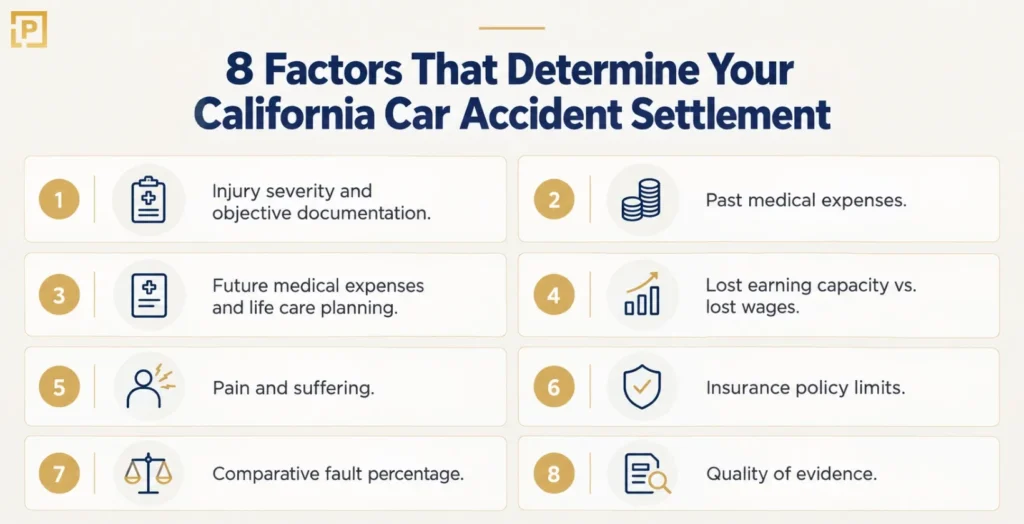
8 Factors That Determine Your California Car Accident Settlement
Ricardo Antonio Pérez started his career at 25 as a licensed private investigator and claims adjuster, so he learned how insurers price a claim before he ever argued one. The eight factors below are the main things adjusters weigh when they build that number. A higher fault percentage assigned to you, or gaps in your medical record, can lower their valuation and the offer that follows.
- Injury severity and objective documentation. The more serious the injury, and the easier it is to prove with tests, the higher the settlement range. Injuries that show up on imaging or testing (fractures, herniated discs, brain injuries confirmed by MRI) make stronger claims than pain reports alone.
- Past medical expenses. Every medical bill on record counts toward your economic damages. Adjusters treat gaps in care as a red flag. A late first doctor visit or a break in treatment lets them argue the injury came from something else or isn’t as serious as you say.
- Future medical expenses and life care planning. Future medical expenses are often where the largest settlement differences occur. Serious injuries that need ongoing care usually call for a life care plan. A life care planner prepares it with your treating doctors, and it estimates what your care will cost over your expected lifetime.
- Lost earning capacity vs. lost wages. Lost wages cover the short-term income interruption during recovery. Lost earning capacity covers the permanent reduction in your ability to earn at the level you could before the crash. The difference can be enormous in serious injury cases and often requires vocational and economic expert testimony to establish.
- Pain and suffering. California places no dollar cap on pain and suffering in car accident cases, because the MICRA cap under California Civil Code §3333.2 covers only medical malpractice. The exception is Proposition 213 (Civil Code §3333.4): uninsured drivers and drivers convicted of DUI for the crash generally cannot recover these damages.
- Insurance policy limits. The at-fault driver’s liability coverage is the most common ceiling on settlement value. When your damages run past it, underinsured motorist coverage on your own policy is the next place to look.
- Comparative fault percentage. Under California’s pure comparative negligence rule, any fault assigned to you cuts your recovery by the same percentage, and the adjuster sets that number in the first evaluation.
- Quality of evidence. A liability case with photographs, witness statements, police reports, and video footage supports a higher value. A weak evidence file gives the adjuster grounds to dispute liability and reduce the offer. Pérez Law, PC sends evidence preservation letters early when footage, vehicle data, or other evidence is at risk.
How Is Pain and Suffering Calculated in a California Car Accident?
Every insurer runs its own review, and many use claims software, but the multiplier method is a common way to estimate pain and suffering during negotiation. It multiplies your economic damages (medical bills plus lost wages) by a factor, often between 1.5 and 5. The number rises with the severity of the injury, the length of treatment, and how much the injury disrupts daily life. California juries are not bound by any formula.
Here is a hypothetical example. Suppose your medical bills total $25,000 and your lost wages total $10,000, bringing economic damages to $35,000. If your injury required surgery and six months of physical therapy and a multiplier of 3 is applied, pain and suffering would be $105,000. Adding that to your $35,000 in economic damages produces a gross claim of $140,000. If you were found 15 percent at fault, your recovery would drop by $21,000 (15 percent of $140,000), leaving $119,000.
The multiplier is not fixed. Adjusters argue for lower multipliers. Attorneys negotiate higher amounts based on the medical record, expert testimony, and how much the injury has changed the client’s daily life and ability to work. The stronger the medical record, the more room there is to push.
Insurance Policy Limits: The Practical Ceiling on Most Claims
California changed its minimum auto insurance requirements on January 1, 2025, under SB 1107. The current minimums are 30/60/15: $30,000 per person, $60,000 per accident, $15,000 for property damage. Some online sources still display the outdated 15/30/5 figures. Those numbers are no longer the legal standard.
For many injured people, the at-fault driver’s policy limit is the practical ceiling on recovery. If your own underinsured motorist (UIM) limit is higher than the at-fault driver’s liability limit, your UIM coverage may pay the difference. A $100,000 UIM policy against a $30,000 liability payment leaves up to $70,000 available. UIM claims generally require the at-fault driver’s policy to be exhausted first. When the at-fault driver’s limits are low, Pérez Law, PC looks for other coverage, including umbrella policies, employer liability, and vehicle owner coverage.
Medical Payments coverage (MedPay) is an optional coverage many drivers carry without knowing it. MedPay reimburses medical expenses from the accident regardless of fault and does not require the liability claim to be resolved first. Check your own policy declarations page before assuming MedPay is unavailable. It can cover treatment costs while your liability claim is pending.
What Happens to Your Settlement If You Were Partly at Fault?
Under California’s pure comparative negligence rule, you can recover even if you share fault for the crash. Your recovery drops by your percentage of fault. If you suffered $150,000 in damages and are found 30 percent at fault, you recover $105,000. If you are found 50 percent at fault, you recover $75,000.
Adjusters assign initial fault percentages in their internal claims evaluation. Those percentages are negotiating positions, not court determinations. Ricardo Antonio Pérez’s years as an adjuster taught him how those first numbers get built. They can be challenged with better evidence, our own investigation, and, when needed, accident reconstruction.
For a full analysis of how the rule applies to your specific crash scenario, see our article on California’s pure comparative negligence rule.
Punitive Damages: When a DUI Crash Opens Additional Recovery
Most California car accident settlements involve only compensatory damages: medical expenses, lost wages, pain and suffering, and property damage. When the at-fault driver was drunk or high, California Civil Code §3294 lets you seek punitive damages on top of compensatory damages.
California public policy bars insurance from paying punitive damages, so any punitive award must be collected from the driver personally. To win punitive damages under California Civil Code §3294, you must prove malice, oppression, or fraud by clear and convincing evidence. That is a higher bar than the more-likely-than-not standard for compensatory damages. California courts have held that voluntarily driving while intoxicated can support a finding of malice (Taylor v. Superior Court (1979) 24 Cal.3d 890). In DUI cases where the driver has personal assets, a punitive award can push total recovery above the policy limits.
If the driver who caused your crash was cited for or convicted of DUI, punitive damages may come into play. Call (877) 622-5888 to discuss how §3294 applies to your situation.
A Real Result: $1,500,000 for a T-Bone Collision in CaliforniaIn a published result, Pérez Law, PC recovered $1,500,000 for a client injured in a T-bone collision that caused a rollover. Each case turns on its own facts, and this result does not predict the outcome of any other case.Cases at the top of these ranges usually share four traits. The injury shows up on objective tests, liability is clear, the medical record is complete, and the damages calculation includes future losses. Past results do not guarantee future results. Every case is different, and the value of any claim depends on its specific facts and the law that applies to it. View all published case results. If your case involves serious injuries and you have questions about how those factors apply to your situation, call (877) 622-5888 for a free case review. |
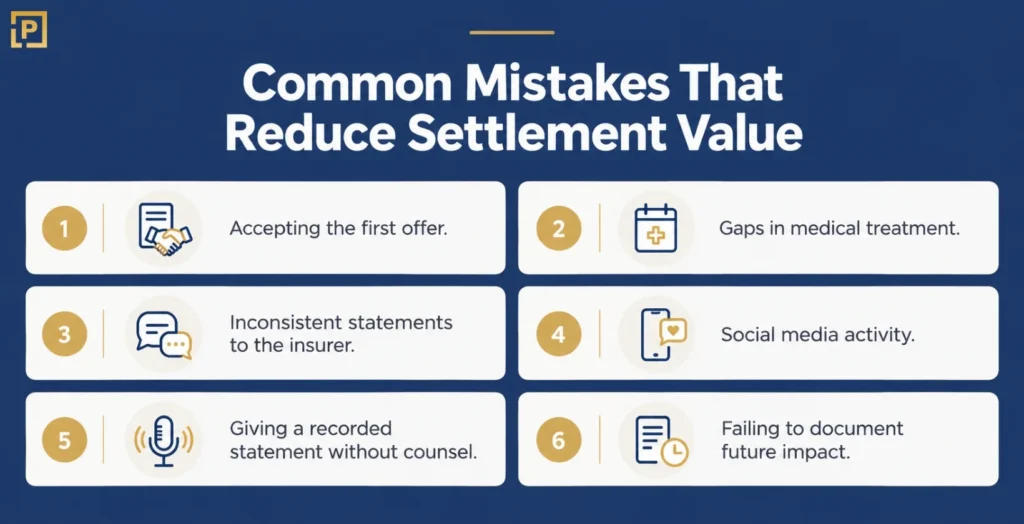
Common Mistakes That Reduce Settlement Value
- Accepting the first offer. The first number an insurer puts on the table is an opening bid, not a fair value. Accepting it closes the claim before the full scope of your injuries is known.
- Gaps in medical treatment. Gaps between treatment appointments can be used by adjusters as evidence that the injury was not serious. Consistent treatment from the accident date forward produces a medical record that is much harder to challenge.
- Inconsistent statements to the insurer. Adjusters review recorded calls for anything that contradicts your later statements. Describing your condition accurately and consistently from the first contact matters throughout the claim.
- Social media activity. Defense teams may review claimants’ social media. A photograph or post showing physical activity can be used to dispute injury severity.
- Giving a recorded statement without counsel. The at-fault driver’s insurer has no legal right to a recorded statement from you. Adjusters often frame the request as a routine procedure. What it produces is a locked-in account that the insurer can use to dispute or reduce your claim.
- Failing to document future impact. Many claimants document current medical bills but do not build a record of future earning limitations, future medical needs, or long-term daily functioning impact. The damage calculation depends on that future record.
Frequently Asked Questions
How Much Is the Average Car Accident Settlement in California?
NAIC’s latest data puts the average California bodily injury liability claim at $31,467 for 2022. That average mixes minor soft-tissue claims with catastrophic losses, so it says little about any single case. In the illustrative ranges above, soft-tissue cases run from about $5,000 to $75,000, and surgery cases from $75,000 to $250,000 and up. Moderate to severe TBI and spinal cord cases can produce settlements well into six or seven figures. Call (877) 622-5888 to discuss where your specific case lands.
What Is the Average Payout for Whiplash in California?
In the illustrative ranges above, whiplash settlements run from about $5,000 to $75,000 in California. Minor cases with short treatment tend to fall at the lower end. Grade II–III whiplash with documented clinical findings, six or more months of treatment, and documented work impact can push toward the top of the range. A concussion from the same crash is a separate injury. See the concussion / mild TBI row in the table above ($20,000 to $100,000).
Should I Accept the First Settlement Offer From the Insurance Company?
No. The first offer is where the insurer starts, not where it expects to finish. Adjusters make early offers before the full extent of injuries is known, before future medical costs are projected, and before a complete damages calculation exists. Most California settlement releases include a waiver of Civil Code §1542. That statute would otherwise protect you from giving up claims you didn’t know about yet. Once you sign a release with that waiver, your claim against the released parties is closed for good. If you need surgery three months later, you generally have no further recourse against the parties you released.
How Long Does a Car Accident Settlement Take in California?
Claims with clear liability and completed treatment can resolve in months. Cases involving surgery, disputed fault, or a lawsuit often take a year or longer. The full value of the claim isn’t clear until treatment is complete or nearly so. Under Code of Civil Procedure §335.1, most California injury lawsuits must be filed within two years of the injury. If a city, county, or state vehicle or roadway was involved, a written government claim is generally due within six months under Government Code §911.2. Other exceptions, including rules for minors, can change the deadline, so get a deadline review early.
How Much of a Settlement Do I Actually Keep?
Your share is the settlement minus three things: attorney fees, case costs, and liens. California requires contingency fee agreements to be in writing and to state the fee rate and how costs affect your recovery (Business and Professions Code §6147). Liens come from whoever paid for your crash-related care and may have a right to repayment, such as Medicare, Medi-Cal, a health plan, or your own MedPay coverage. For licensed health plans and insurers, Civil Code §3040 caps that repayment at one-third of your recovery when you have an attorney.
Do I Need a Lawyer for a Car Accident Settlement in California?
You are not required to hire an attorney. An attorney can find every insurance policy that applies and document the future losses insurers tend to discount. That lets you negotiate from your full damages, not from the insurer’s early offer. Pérez Law, PC handles car accident cases on a contingency fee, so there is no attorney fee unless we recover compensation for you. Depending on your fee agreement and the outcome, you may remain responsible for certain case costs.
Find Out What Your Inland Empire Car Accident Case Is Worth
An early offer from the insurer reflects its evaluation of your case, not yours. The two numbers are rarely the same.
Call (877) 622-5888 or start a free case evaluation online. Bring the offer you received. We’ll walk you through how an adjuster likely arrived at that number. We’ll also show whether it covers your full losses, including future medical care and lost earning capacity.

Pérez Law, PC serves clients across the Inland Empire and Pomona Valley from two offices. Our Ontario car accident lawyers are at 822 N Euclid Ave, Ontario, CA 91762. Our Pomona car accident lawyer team is at 522 W Holt Ave, Pomona, CA 91768, and is available for crash victims along the 71 and 60 corridors.
View all published case results. Past results do not guarantee future results. Every case is different, and the value of any claim depends on its specific facts and the law that applies to it.