
Pérez Law, PC is a plaintiff-side personal injury firm serving Pomona and the surrounding Pomona Valley from our office at 522 W Holt Ave, Pomona, CA 91768. If you or someone you love sustained a traumatic brain injury in an accident, our Pomona traumatic brain injury lawyer team handles TBI cases with the medical evidence depth these claims require.
Founded in 1998 by Ricardo Antonio Pérez (CA Bar #194646), the firm has spent nearly three decades representing injured Californians against insurance companies and corporate defendants. Our attorneys have reviewed the full arc of serious-injury cases, from emergency room discharge to life care plan deposition, and understand the medical documentation sequence that distinguishes a fully developed claim from one that settles at fractions of its true value. Our firm has recovered significant results for seriously injured clients, including a $1,500,000 recovery for a client injured in a T-bone collision that caused a rollover accident. That case was a motor vehicle injury matter, not a brain injury claim, but it reflects the same evidence-building and insurer-negotiation work that serious TBI cases demand.
Brain injury recoveries do not follow a simple timeline. The firm’s case results reflect multi-year cases where persistence and medical documentation depth made all the difference. If you need a Pomona traumatic brain injury lawyer who will stay with your case through every stage of recovery, call (909) 622-1071 for a free case evaluation, available 24 hours a day, 7 days a week.
Past results do not guarantee future outcomes. Every case is different.
What a Traumatic Brain Injury Actually Is
A traumatic brain injury (TBI) is any injury caused by an external force, including a blow, jolt, or penetrating impact, that disrupts normal brain function. The injury does not have to be catastrophic to qualify as a legal TBI, and many of the most costly TBIs are classified as mild or moderate on the clinical scale.
- Mild TBI (Concussion): A mild TBI involves a brief or no loss of consciousness, disorientation of up to 24 hours, and an altered mental state at the time of injury. Post-traumatic amnesia, if present, resolves within 24 hours. Standard imaging (CT, MRI) typically returns normal results. Despite the label, mild TBI can produce long-term cognitive impairment, especially post-concussion syndrome that persists beyond three months.
- Moderate TBI: Moderate TBI involves loss of consciousness lasting between 30 minutes and 24 hours, post-traumatic amnesia lasting 1 to 7 days, and Glasgow Coma Scale scores of 9 to 12. Structural brain changes may appear on advanced imaging. Recovery timelines extend well past the acute phase, and the long-term costs generate substantial damage calculations.
- Severe TBI: Severe TBI is marked by loss of consciousness exceeding 24 hours, post-traumatic amnesia lasting more than 7 days, and Glasgow Coma Scale scores of 3 to 8. These cases involve a high probability of permanent disability, require intensive medical management, and generate the largest potential damages in personal injury law.
TBI Symptoms You Must Document Early
Traumatic brain injury produces symptoms across three categories. Documenting all of them from the earliest possible point is not just medically important. It is the foundation of a defensible legal claim. Insurers will look for any gap between the accident and your first complaint of cognitive or behavioral symptoms as a basis for arguing the injury is not serious or not related to the accident.
- Cognitive Symptoms: Cognitive symptoms are the most commonly dismissed by insurance adjusters and the most important to document precisely. They include memory loss, difficulty concentrating, slowed processing speed, word-finding difficulties, and confusion in complex environments. These symptoms are invisible and do not appear on standard imaging, which is exactly why carriers undervalue them.
- Physical Symptoms: Physical symptoms, such as persistent headache, dizziness, light sensitivity, sound sensitivity, visual disturbances, fatigue, sleep disruption, and tinnitus, overlap with unrelated conditions, which is why medical documentation from the date of injury forward matters so much. An insurer’s examiner will use any diagnostic ambiguity to minimize the injury.
- Behavioral and Emotional Symptoms: Behavioral and emotional symptoms, including irritability, emotional dysregulation, depression, personality changes noted by family members, and social withdrawal, are often the most disruptive to daily function and employment. Family members who notice changes are important witnesses. Their observations should be documented early.
- Immediate vs. Delayed Onset: Some symptoms appear within minutes. Others, including many cognitive and behavioral symptoms, emerge days or even weeks after the accident. Delayed onset is a documented feature of TBI, not evidence of a minor injury. The medical literature establishes the delayed-onset mechanism clearly, and the right expert witnesses can explain it to a jury.

Why Delayed Medical Care Can Weaken a TBI Claim
The most damaging thing a TBI victim can do after an accident is wait to seek medical care. Insurance adjusters are trained to frame any gap between the accident date and your first symptom complaint as evidence that the injury is not serious or not related to the accident. This framing does not require proof. It only requires the gap.
The correct sequence is: seek emergency evaluation immediately after the accident, even if you feel okay; report every symptom that appears in the days that follow; follow through on every specialist referral; and keep a written daily log of how symptoms affect your work, relationships, and daily function. Pomona Valley Hospital Medical Center (PVHMC), 1798 N Garey Ave, Pomona, provides the emergency neurological evaluation that creates the foundational medical record.
The insurer will move fast to schedule its own Independent Medical Examination (IME). These examinations are conducted by physicians selected and paid by the insurance company. They are not independent in any practical sense. The preparation you do before that examination, and the expert evidence your attorney builds before it, determines how much weight the IME report carries.
A Pomona traumatic brain injury lawyer from Pérez Law, PC, can walk you through this process before the insurer schedules anything. Call (909) 622-1071 before you agree to any examination.
How TBI Cases Differ from Standard Personal Injury
A straightforward personal injury case may resolve in months. A TBI case can take years, and the difference is not inefficiency. It is the nature of the injury itself. Settling a TBI claim before the full medical picture is clear is one of the most common and most costly mistakes an injured person can make.
- Multi-Year Recovery Trajectories: Brain injuries do not resolve on an insurer’s preferred timeline. Cognitive rehabilitation, neurological follow-up, and psychological support can extend well into the second or third year post-injury. A settlement that covers only the first year of treatment leaves the injured person personally responsible for the years of care that follow.
- Disputed Causation: The defense will challenge whether your current symptoms are caused by the accident. Prior medical history, prior accidents, mental health records, and any documentation that predates the injury will be used. Building causation requires connecting the accident to the injury with expert neurological testimony that can withstand cross-examination.
- IME Abuse: Independent Medical Examinations arranged by insurance companies are a standard defense tactic in TBI cases. The physicians who conduct them are paid by the insurer; they have financial incentives to minimize findings, and their reports are designed to support the insurer’s position. Countering an unfavorable IME requires a thorough neuropsychological evaluation, advanced imaging, and expert witnesses who can explain the methodology differences to a jury.
Common Causes of TBI in Pomona
Pomona sits at the intersection of the I-10 and CA-71 corridors, with high-volume commuter traffic on Holt Avenue, Garey Avenue, and surrounding arterials. The combination of freeway access, commercial truck routes, and dense residential neighborhoods creates multiple high-risk scenarios for brain injury.
- Motor Vehicle Accidents: Car accidents are the leading cause of TBI in the Pomona area. High-speed impacts on the I-10 corridor, rear-end collisions at major intersections, and T-bone crashes at uncontrolled intersections all produce the rotational and linear forces that cause brain injury. Our Pomona car accident lawyer practice handles TBI-related motor vehicle claims with the medical documentation protocol these cases require.
- Truck Accidents: Commercial truck accidents produce the most severe TBIs. The mass differential between a loaded semi-truck and a passenger vehicle transfers enormous force in any collision. Truck accident TBI cases involve additional layers of insurance coverage, federal safety regulation compliance, and potential trucking company liability. Our Pomona truck accident lawyer practice manages these complex coverage and liability structures.
- Motorcycle Accidents: Motorcycle riders sustain TBIs even when wearing helmets, and the injury mechanics differ from enclosed-vehicle crashes. Ejection, road contact, and secondary impacts all contribute to brain injury in motorcycle collisions. Our Pomona motorcycle accident lawyer practice addresses the rider bias issues that complicate motorcycle TBI claims in settlement negotiations.
- Slip and Fall Accidents: Premises liability falls are a major cause of TBI in Pomona, particularly on commercial properties, in parking structures, and at retail locations. When a fall results in a head strike, the property owner’s knowledge of the hazard and failure to correct it must be established through the same notice doctrine framework our Pomona slip and fall lawyer practice applies in all premises liability TBI cases.
- Other Causes: Pedestrian accidents, bicycle collisions, assault and battery, and workplace incidents also cause TBI. If an accident near Pomona Valley or anywhere in Los Angeles County resulted in a brain injury, Pérez Law, PC serves clients throughout the region. In cases involving a fatal TBI, our Pomona wrongful death lawyer team handles the surviving family’s claims.
Building the Medical Evidence That Wins a TBI Claim
A TBI diagnosis alone does not win a claim. The evidentiary chain must connect the accident to the injury, document the injury’s impact on function, and project the future costs that a settlement must cover.
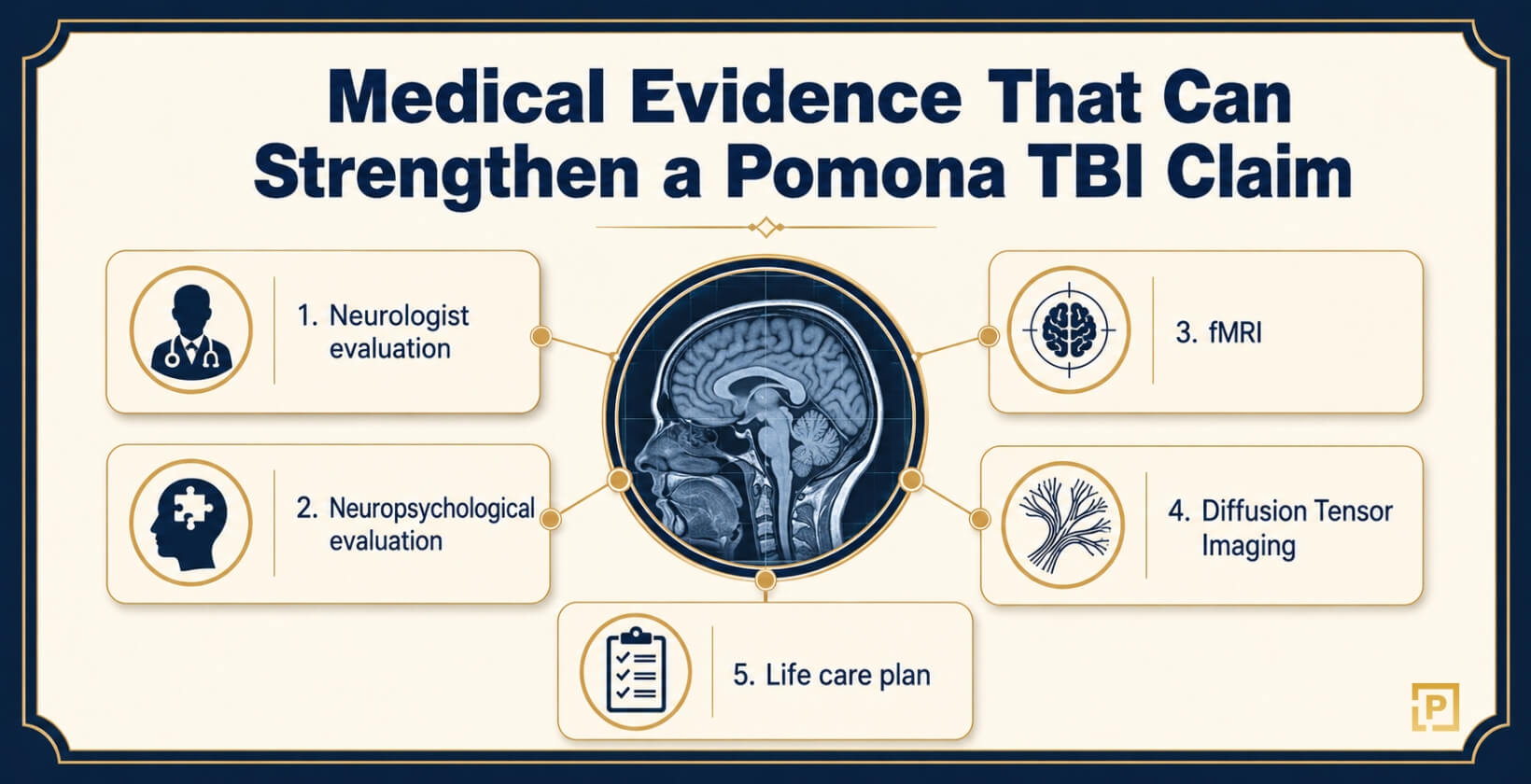
- Neurologist Evaluation: A board-certified neurologist provides the foundational clinical assessment. Neurological evaluation documents the injury’s effect on brain structure and function, establishes the clinical diagnosis, and supports causation arguments linking the injury to the accident event. Early neurological evaluation, ideally at Pomona Valley Hospital Medical Center (PVHMC) or through an outpatient specialist, creates the anchor record for the entire claim. When a client delays this visit, the firm’s first task is to explain the gap before the defense can weaponize it.
- Neuropsychological Evaluation: Neuropsychological testing measures what standard imaging cannot: cognitive function, processing speed, memory performance, attention, and executive function. This testing generates a quantitative before-and-after comparison, especially powerful when pre-injury baseline data is available from prior employment, educational, or military records. Insurance IME physicians routinely minimize cognitive complaints; an independent neuropsychological evaluation counters that minimization with objective data.
- Advanced Imaging: fMRI and DTI: Functional MRI (fMRI) and diffusion tensor imaging (DTI) detect white matter tract disruptions and functional connectivity changes that standard CT and MRI miss. These imaging modalities are particularly important in mild TBI cases where standard imaging is normal but cognitive symptoms are severe. DTI findings can demonstrate the structural basis for cognitive deficits that an insurer’s physician claims are psychological rather than neurological.
- Life Care Plan: A certified life care planner projects the full cost of future care over the injured person’s remaining life expectancy. Life care plans account for specialist visits, medication, cognitive rehabilitation, assistive technology, home modification, caregiver costs, and lost earning capacity. In moderate and severe TBI cases, the life care plan is frequently the single most important document in the case.
The Pre-Existing Condition Defense
If you have ever had a prior head injury, prior concussion, prior mental health treatment, or any medical history that the defense can characterize as brain-related, they will use it. This is one of the most aggressive and most common defenses in TBI litigation. The legal doctrine that limits this defense is the eggshell plaintiff rule, which holds that a defendant takes the plaintiff as they find them. A prior vulnerability does not eliminate liability for a new injury. However, the defense will argue that your current symptoms are attributable to the prior condition rather than the accident, and countering that argument requires precise medical analysis of what existed before versus what changed after the impact. The same prior history that the defense will try to weaponize against you can also establish how significantly the accident changed your baseline. A meticulous pre-accident record review is not something to dread. It is a tool for demonstrating exactly what the accident cost you.
What California Law Says About TBI Claims
Three California statutes directly affect the value of your claim, your right to file it, and the deadline for doing so. Understanding these laws in plain language is part of what we explain in every free case evaluation.
Statute of Limitations: CCP Section 335.1
California Code of Civil Procedure Section 335.1 establishes a two-year statute of limitations for personal injury claims, including TBI. The clock generally starts on the date of the accident. If a TBI victim sustains injuries and does not discover the full extent of their neurological damage until months later, the discovery rule may toll the limitations period, but relying on the discovery rule is a legal argument that must be made, not an automatic protection.
Government Entity Claims: Government Code Section 911.2
If your TBI was caused by a government employee, a government-owned vehicle, or a condition on government-maintained property, such as a pothole on a county road near the I-10 corridor, you must file an administrative claim within six months of the date of injury under Government Code Section 911.2. This deadline is strict, with only narrow exceptions available under Gov. Code §911.4. Contact an attorney immediately if government involvement is possible.
Comparative Fault: Li v. Yellow Cab Co. (1975)
California follows a pure comparative fault system established by the California Supreme Court in Li v. Yellow Cab Co., 13 Cal. 3d 804 (1975). If you are found partially at fault for the accident that caused your TBI, your recovery is reduced proportionally but not eliminated. For example, if you are found 20 percent at fault and your TBI damages are assessed at $1,000,000, you recover $800,000. If litigation becomes necessary, fault allocation is decided by a jury at the Los Angeles County Superior Court, Pomona Courthouse, 400 Civic Center Plaza, Pomona, CA 91766.
Economic Damages in a TBI Case
TBI cases generate the largest potential economic damage awards in personal injury law. The reason is the long timeline. Unlike a soft-tissue injury that resolves in months, a moderate or severe TBI may involve decades of medical costs, care costs, and lost earnings.
- Lifetime Medical Care: Emergency costs are typically the smallest component of TBI economic damages. The higher costs are ongoing: specialist visits, medication management, cognitive rehabilitation sessions, psychological treatment, neurological monitoring, and potential future hospitalizations. A life care plan quantifies these costs as a present-value figure that the jury can evaluate as a whole.
- Lost Earning Capacity: TBI can permanently reduce a person’s ability to perform at their pre-accident occupational level, even if they technically return to work. Reduced productivity, increased errors, reduced hours, missed promotions, and eventual departure from a career field are all documentable forms of earning capacity loss. Economic expert testimony translates these functional limitations into a dollar figure.
- Caretaker and Home Assistance Costs: Many moderate and severe TBI survivors require ongoing assistance with activities of daily living: personal hygiene, meal preparation, transportation, medication management, and supervision. Unpaid family caretaking hours carry a documented market value under California law. Professional caretaker costs are calculated from regional market rates. Both are compensable and must be included in the damages demand.
Why Pérez Law, PC for a Pomona TBI Claim
Ricardo Agustín Pérez is the managing attorney at Pérez Law, PC, and a second-generation lawyer who grew up working in this firm. He has overseen thousands of injury cases and helped secure tens of millions of dollars in settlements, including complex catastrophic cases involving commercial insurance, amputations, and traumatic brain injuries. CA Bar #297967, admitted 2014.
The firm was founded in 1998 by Ricardo Antonio Pérez (CA Bar #194646), who spent years before law school as a licensed private investigator and claims adjuster. That experience gives him a working understanding of how insurance companies document and evaluate injury claims from the inside, and that perspective informs how the firm builds and sequences its evidence. Carriers commonly try to close serious-injury files through low-value IME scheduling, delayed-onset arguments, and pre-existing condition defenses. This firm is built to anticipate and counter those tactics.
Pérez Law, PC is located at 522 W Holt Ave, Pomona, CA 91768, one block from the Holt Avenue corridor and accessible from both I-10 and CA-71. The Pomona office is wheelchair accessible with dedicated parking.
Past results do not guarantee future outcomes. Every case is different.
No Upfront Cost: How Contingency Works in TBI Cases
Pérez Law, PC, handles TBI claims on a contingency fee basis. You pay no attorney fees unless we recover compensation for you. The firm advances case costs, including expert witness fees, medical record procurement, specialist consultation, and litigation expenses, and those costs are recovered from the final settlement or judgment. This model matters in TBI cases specifically because the most important work, building the neurological evidence, retaining life care experts, preparing for IME depositions, often happens long before any settlement conversation.
Free consultations are available 24 hours a day, 7 days a week. Call (909) 622-1071 or start a free case evaluation online to review your situation with no financial obligation.
Bilingual TBI Legal Help in Pomona
Pérez Law, PC, provides full legal representation in both English and Spanish. The firm serves the Pomona community, including Diamond Bar, Walnut, La Verne, San Dimas, Claremont, and nearby communities in eastern Los Angeles County, with bilingual staff available throughout the representation.
Brain injury is a difficult subject to navigate in any language. When medical terminology, legal process, and insurance tactics must all be explained and understood, language barriers compound an already stressful situation. Our firm’s bilingual capability is not a feature. It is a practice standard. Hablamos español. Si usted o un familiar sufrieron una lesión cerebral traumática en Pomona o el Valle de Pomona, llámenos al (909) 622-1071 para una evaluación de caso gratuita.
Frequently Asked Questions: Pomona TBI Claims
Does a Normal CT Scan or MRI Mean I Do Not Have a TBI?
No. Standard CT and MRI imaging frequently returns normal results even when a genuine traumatic brain injury has occurred. The structural changes associated with mild to moderate TBI often fall below the detection threshold of these imaging modalities. Functional MRI, diffusion tensor imaging, and neuropsychological testing detect impairment that standard imaging misses.
What If My TBI Symptoms Did Not Appear Until Days After the Accident?
Delayed symptom onset is a recognized and documented feature of traumatic brain injury. It does not invalidate your claim. The critical factor is your response: seeking medical evaluation promptly when symptoms appear, following through on specialist referrals, and maintaining a daily symptom log from the day they begin.
Can I Still File a TBI Claim If I Was Partly at Fault for the Accident?
Yes. California uses a pure comparative fault system established by the California Supreme Court in Li v. Yellow Cab Co., 13 Cal. 3d 804 (1975). You can recover damages even if you share some responsibility for the accident. Your award is reduced by your percentage of fault. If your TBI damages are assessed at $900,000 and you are found 15 percent at fault, you recover $765,000.
How Long Do I Have to File a TBI Lawsuit in California?
The general statute of limitations for personal injury under California Code of Civil Procedure Section 335.1 is two years from the date of the accident. When a government entity is involved, an administrative claim must typically be filed within six months under California Government Code Section 911.2.
How Much Is a TBI Case Worth in California?
There is no fixed number, and any attorney who quotes a number before reviewing your medical records should be treated with caution. TBI case value depends on injury severity and classification, projected lifetime medical costs, the injured person’s age and pre-accident earning capacity, the strength of the causation evidence, and the insurer’s coverage limits.
What Is an Independent Medical Examination, and Do I Have to Comply?
An IME is a medical examination arranged and paid for by the opposing insurance company. The physician conducting it is selected by and paid by the insurer. California law governs when and how an IME can be demanded, and your attorney can negotiate the terms.
Does Pérez Law, PC Handle TBI Cases Throughout Los Angeles County?
Yes. While our Pomona office at 522 W Holt Ave serves as our local base for the Pomona Valley and eastern Los Angeles County, Pérez Law, PC represents clients throughout Los Angeles County, San Bernardino County, and the broader Inland Empire.
Contact a Pomona Traumatic Brain Injury Lawyer Today
If a brain injury has changed your life or the life of someone you love, the first step is a conversation. Pérez Law, PC offers free case evaluations 24 hours a day, 7 days a week. There is no cost to speak with us, no obligation to retain us, and no attorney fee unless we recover compensation for you.
Pérez Law, PC is located at 522 W Holt Ave, Pomona, CA 91768. We serve clients throughout the Pomona Valley, Los Angeles County, and the Inland Empire. If the TBI resulted in a wrongful death, our Pomona wrongful death lawyer team is ready to evaluate the family’s claim.
Trusted Injury Lawyers. Decades of Experience. Millions Recovered.
Call (909) 622-1071 or toll-free (877) 622-5888. Available 24/7. Start a free case evaluation. We work on contingency, no win, no fee.