
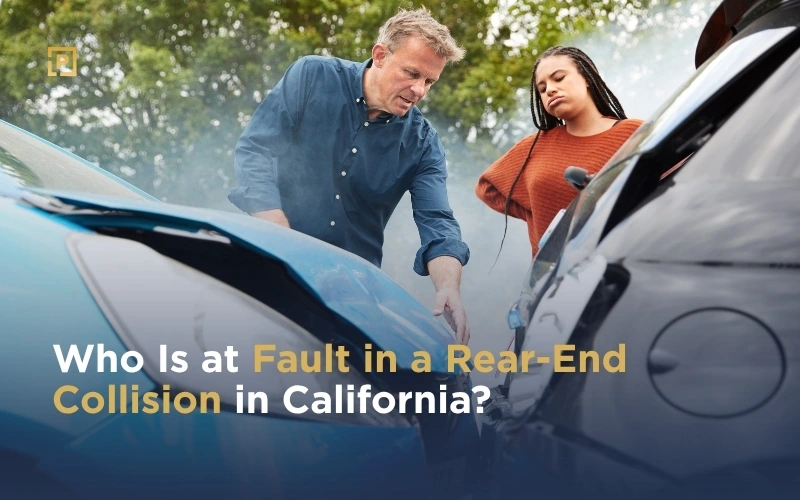
The rear driver is usually at fault in a California rear-end collision because state law requires drivers to maintain a safe following distance. But that fault is not automatic. A front driver can share or carry full blame for brake-checking, dead brake lights, reversing, or an unsafe lane change. When fault is shared, pure comparative negligence reduces each driver’s recovery by that driver’s share of fault.
If you were rear-ended on the I-10, SR-60, or Holt Avenue and the other driver’s insurer is using one of these exceptions to blame you, our California car accident lawyer can review your rear-end case in a free, confidential consultation.
Key Takeaways
- Who is usually at fault? The rear driver, under the following-distance rule in Vehicle Code § 21703.
- Is rear driver’s fault automatic? No. Courts treat it as an inference a jury can reject.
- When does fault shift? Brake-checking, unsafe cut-ins, reversing, and dead brake lights.
- Can fault be shared? Yes. Pure comparative negligence reduces each driver’s recovery by that driver’s share.
- Which deadlines apply? Generally, an injury lawsuit within 2 years, a government claim within 6 months, and an SR-1 within 10 days when required.
When the Rear Driver Is at Fault
The rear driver is at fault in most California rear-end collisions because Vehicle Code § 21703 prohibits following another vehicle more closely than is reasonable and prudent for the speed, traffic, and road conditions.
The basic speed law, Vehicle Code § 22350, adds a second duty: drive no faster than conditions allow, even below the posted limit. A rear driver who could not stop in time usually broke one of these two rules.
Common driver errors behind rear-end crashes on Inland Empire freeways and surface streets include:
- Tailgating in stop-and-go traffic on the I-10 and SR-60
- Phone use, navigation screens, and other distractions
- Speed too high for rain, fog, or congestion
- Fatigue or impairment behind the wheel
Insurance adjusters often treat the following-distance rule as a presumption of fault and open the claim assuming the rear driver pays, but California courts do not. Under Beck v. Kessler (1965), a rear-end collision creates only a permissible inference of negligence: the rear driver can offer an explanation, and a jury decides whether to accept it.
The rules are stricter when the rear driver breaks a traffic law. Under Evidence Code § 669, that violation creates a rebuttable presumption of negligence if it caused the injury and the statute covers that victim and harm. The rear driver must then prove they acted as a reasonably careful driver would.
When the Front Driver May Be at Fault
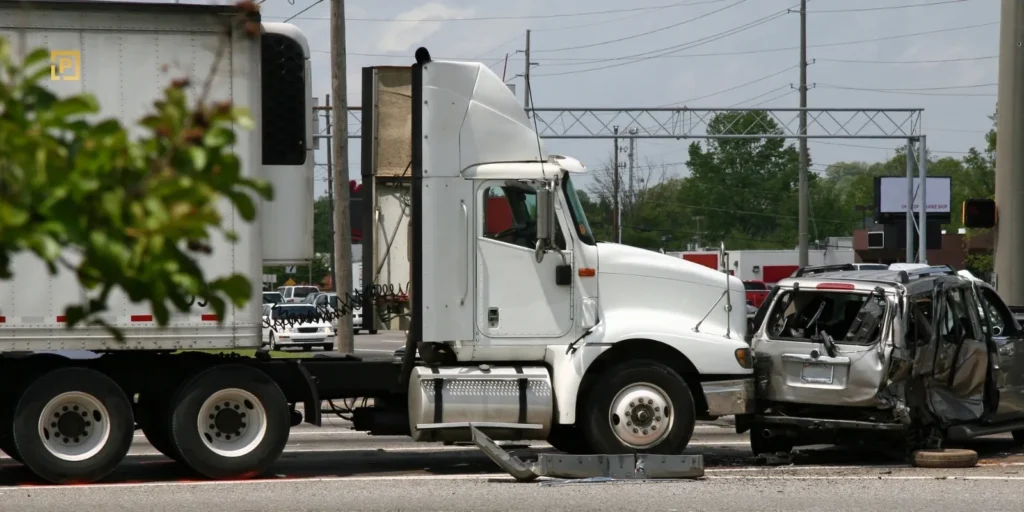
While the rear driver is usually at fault, a front driver can share or carry full liability by violating specific California Vehicle Code rules:
| Front-Driver Conduct | California Rule | Effect on Fault |
|---|---|---|
| Brake-checking or stopping suddenly without a signal | Vehicle Code § 22109 | An unsignaled stop, when signaling was possible, can shift blame forward. |
| Cutting into your lane and braking | Vehicle Code § 22107 | A lane change made without reasonable safety can leave you no room to stop and shift blame forward. |
| Reversing in traffic or out of a street parking space | Vehicle Code § 22106 | Backing before it is reasonably safe can put fault on the reversing driver. |
| Burned-out or disconnected brake lights | Vehicle Code § 24603 | Stoplamps must be visible from 300 feet; without them, you may have had no warning to brake. |
Proving these violations depends on evidence. Dashcam video, event data recorder logs, traffic camera footage, and witness accounts often decide disputed fault, and some of this evidence can be overwritten or lost quickly.
When a Third Party Shares Fault in a Rear-End Crash
A third party may share responsibility for a California rear-end crash when a defective part, a negligent repair, or a dangerous road contributes to the collision, or when the at-fault driver was working for an employer. Identifying these non-driver parties matters because each added defendant may carry separate insurance coverage:
- Manufacturers: When defective brakes or other vehicle parts fail and prevent a vehicle from stopping.
- Repair shops: When a negligent brake job or mechanical repair leaves a vehicle unsafe.
- Government agencies: When a missing signal or road defect causes the crash. A written claim is due within six months under Government Code § 911.2.
- Employers: When an employee causes the crash while driving within the scope of the job, under the doctrine of respondeat superior (vicarious liability).
Chain-Reaction Crashes and Multiple At-Fault Drivers
Chain-reaction crashes add more drivers to the fault analysis. Each impact is evaluated separately: a driver who strikes the last car in line and pushes it forward usually bears fault for both impacts, while a middle driver who hit the car ahead before being struck from behind may share fault for that first collision. Vehicle damage patterns, event data recorder downloads, and police reports help establish the sequence.
How Shared Fault Affects Your Rear-End Accident Compensation in California
Under California’s pure comparative negligence system (Li v. Yellow Cab Co.), shared fault reduces your recovery by your exact percentage of blame. Even a driver found 90% at fault can still recover 10% of their damages.
For example, if a jury values your claim at $100,000 but finds you 20% at fault for following too closely, your final award is $80,000. Fault can also shift the other way: if the front driver brake-checked you, they might take 40% of the blame even though you hit them. Because every percentage point changes the payout, insurers often dispute fault allocation.
Your percentage reduction applies to all eligible damages, including medical bills, lost income, vehicle repairs, and pain and suffering. However, California law places an additional restriction on uninsured drivers and owners.
Under Proposition 213 (Civil Code § 3333.4), an uninsured driver or owner cannot recover non-economic damages like pain and suffering, even if the other driver was 100% at fault. Medical bills and lost wages remain recoverable. This rule does not apply to passengers who neither owned nor drove the uninsured car, and an uninsured owner keeps the right to pain and suffering if the at-fault driver was convicted of DUI for that crash.
What to Do After a Rear-End Accident in California
After a rear-end accident in California, get medical care, document both vehicles, report the crash, and guard your statements, because evidence that proves fault can disappear within days.
- Call 911 and request a report. CHP generally handles freeway crashes on the I-10, I-15, SR-60, SR-57, and SR-71, and city police handle city streets.
- Photograph available evidence in the crash scene. Capture damage to bumpers and brake lights, skid marks, and the lane or signal where the impact happened.
- Collect names and phone numbers from witnesses before they leave.
- Save your dashcam footage and ask an attorney to send a preservation letter for the other vehicle’s event data recorder.
- See a doctor as soon as possible. Some injuries, such as whiplash or traumatic brain injury (TBI), may not show symptoms right away. Area trauma centers include Pomona Valley Hospital Medical Center, a Level II trauma center, and Arrowhead Regional Medical Center in Colton, a Level I trauma center.
- Decline the other insurer’s request for a recorded statement until you have legal advice.
- File an SR-1 report with the DMV within 10 days if anyone was hurt or property damage exceeded $1,000.
- Track your deadlines. You generally have two years to file an injury lawsuit under Code of Civil Procedure § 335.1, and three years for property damage under § 338.
Our guide on what to do after a car accident in California covers each step in more detail.
Hurt near Ontario or Pomona? Pérez Law, PC serves clients across the Inland Empire and Pomona Valley from two offices.
Ontario car accident lawyer | 822 N Euclid Ave, Ontario, CA 91762
Pomona car accident lawyer | 522 W Holt Ave, Pomona, CA 91768
FAQs About Fault in CA Rear-End Crashes
Can I File a Claim If I Rear-Ended Someone Who Stopped Suddenly?
Yes, you can file a car accident claim if the driver you rear-ended stopped suddenly without a signal or deliberately brake-checked you. California’s pure comparative negligence rule lets you recover the share of your damages that driver’s negligence caused. Your own following distance still counts against you, so expect fault to be split.
Do I Need a Lawyer to Handle My Rear-End Collision Case?
No, California does not require a lawyer for a rear-end claim. A minor claim with no injuries and no fault dispute often resolves directly with the insurer. A lawyer adds value when the insurer blames you, when injuries need ongoing treatment, or when the case may go to court.
What If the At-Fault Driver Has No Insurance?
If the at-fault driver has no insurance, your own uninsured motorist (UM) coverage pays for your injuries up to your policy limits, provided your policy includes it. California insurers must offer UM coverage, and it stays on your policy unless you rejected it in writing. Underinsured motorist (UIM) coverage adds protection when the other driver carries only California’s minimum liability limits ($30,000 per person / $60,000 per accident), and your own UIM limits are higher.
What Is the Average Settlement for a Rear-End Collision in California?
It varies, and no reliable statewide average exists for rear-end settlements. Value depends on five factors: medical costs, lost income, injury severity and duration, your share of fault, and the available insurance limits. A soft-tissue claim against a minimum-limits policy resolves for far less than a surgery case against a commercial policy. Read our guide on how car accident settlements work in California.
Call Pérez Law Before You Accept the Insurer’s Fault Decision
The insurer’s first fault decision in a rear-end crash is a negotiating position, and evidence can change it. Our founder, Ricardo Antonio Pérez, worked as an insurance claims adjuster before joining the California Bar in 1998, so he knows firsthand how those decisions get written.
Call (877) 622-5888 24/7 or start a free case evaluation online with no upfront fee. Hablamos español.
Trusted Injury Lawyers. Decades of Experience. Millions Recovered.